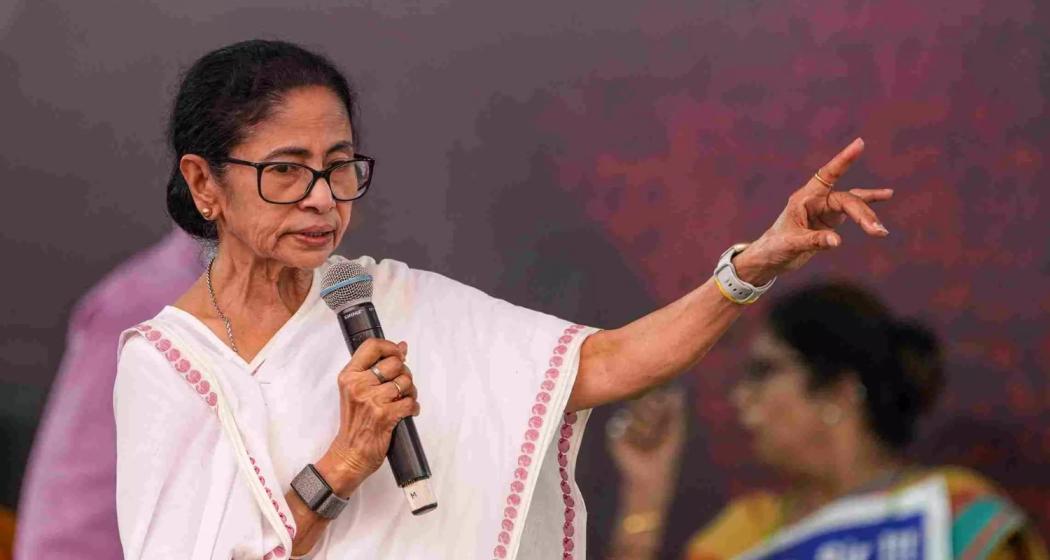
Political tensions have escalated in West Bengal after a formal complaint was filed against former Chief Minister Mamata Banerjee over her recent remarks linked to a killing in Bangladesh.
A written complaint was lodged at the Siliguri Cyber Crime Police Station by advocate Rinku Chattopadhyay Singh, who practises at the Jalpaiguri Circuit Bench of the Calcutta High Court. The complaint alleges that Mamata Banerjee made statements that insult the country’s constitutional framework, promote enmity, and could strain diplomatic relations with neighbouring Bangladesh.
According to the complainant, the remarks were made during a protest programme in Kolkata on June 2. A significant portion of the complaint focuses on her alleged comments regarding Bangladesh. The lawyer claimed that during a rally at the Y Channel in Dharmatala on June 2, Mamata Banerjee accused the Indian government and the Union Home Minister of involvement in the killing of a Bangladeshi political figure.
Calling the remarks “serious and damaging,” the complainant said such allegations could harm India’s international reputation and potentially create diplomatic tensions between the two countries. She further argued that the statements could incite unrest and pose risks to public safety, including concerns over communal harmony.
The complaint alleges violations under multiple sections of the Bharatiya Nyaya Sanhita (BNS), including provisions related to promoting enmity, spreading misinformation, and endangering national integrity.
Speaking to reporters, the complainant said she intends to move the High Court seeking further legal action, including a plea for arrest, once proceedings resume on June 8. He has also called for an impartial and comprehensive investigation into the matter.
The complainant also alleged that Mamata Banerjee questioned the neutrality and credibility of key institutions such as the Election Commission and central armed forces, which she described as an attempt to create mistrust among the public towards the Central government.
At the protest rally, Mamata Banerjee had alleged that she possesses crucial information about the killing of a Bangladeshi political activist but chose not to disclose details, citing the risk of unrest. She further claimed that Union Home Minister Amit Shah had personally requested her to keep information regarding the arrest of suspects confidential in the “national interest.”
“I know who carried out the murder. Even if the government changes today, I still know everything,” Mamata Banerjee had said, adding that revealing names could lead to turmoil in Bangladesh.
Her comments appeared to refer to the killing of Sharif Osman bin Hadi, a spokesperson of Bangladesh’s Inquilab Mancha, whose murder had triggered widespread unrest. Earlier this year, the West Bengal Police’s Special Task Force (STF) arrested key suspects in connection with the case.
According to police sources, the main accused, Faisal Karim Masud alias Rahul, and Alamgir Hossain had entered West Bengal via Meghalaya before being apprehended. Another accused, Philip Sangma, was later arrested near Shantipur in Nadia district. The Detective Branch of Dhaka Metropolitan Police had earlier identified Faisal as the principal suspect.
While Mamata Banerjee did not explicitly name the case, her references to arrests and subsequent developments have intensified speculation over her claims.
Reacting to her remarks, Bangladesh’s State Minister for Foreign Affairs, Shama Obaed, said Dhaka would not comment on statements made by a political leader in another country, adding that the matter is being handled through official diplomatic channels.
“There has been an election in another country, and a political leader has made certain remarks. That is not our matter to discuss,” Obaed told the media. She added that Bangladesh remains focused on securing justice in the murder case and is engaging with the Government of India.
There has been no immediate response from Mamata Banerjee or her party regarding the allegations.
The development has triggered intense discussions in political and administrative circles across the state, with further action by authorities being closely watched.



 Follow us