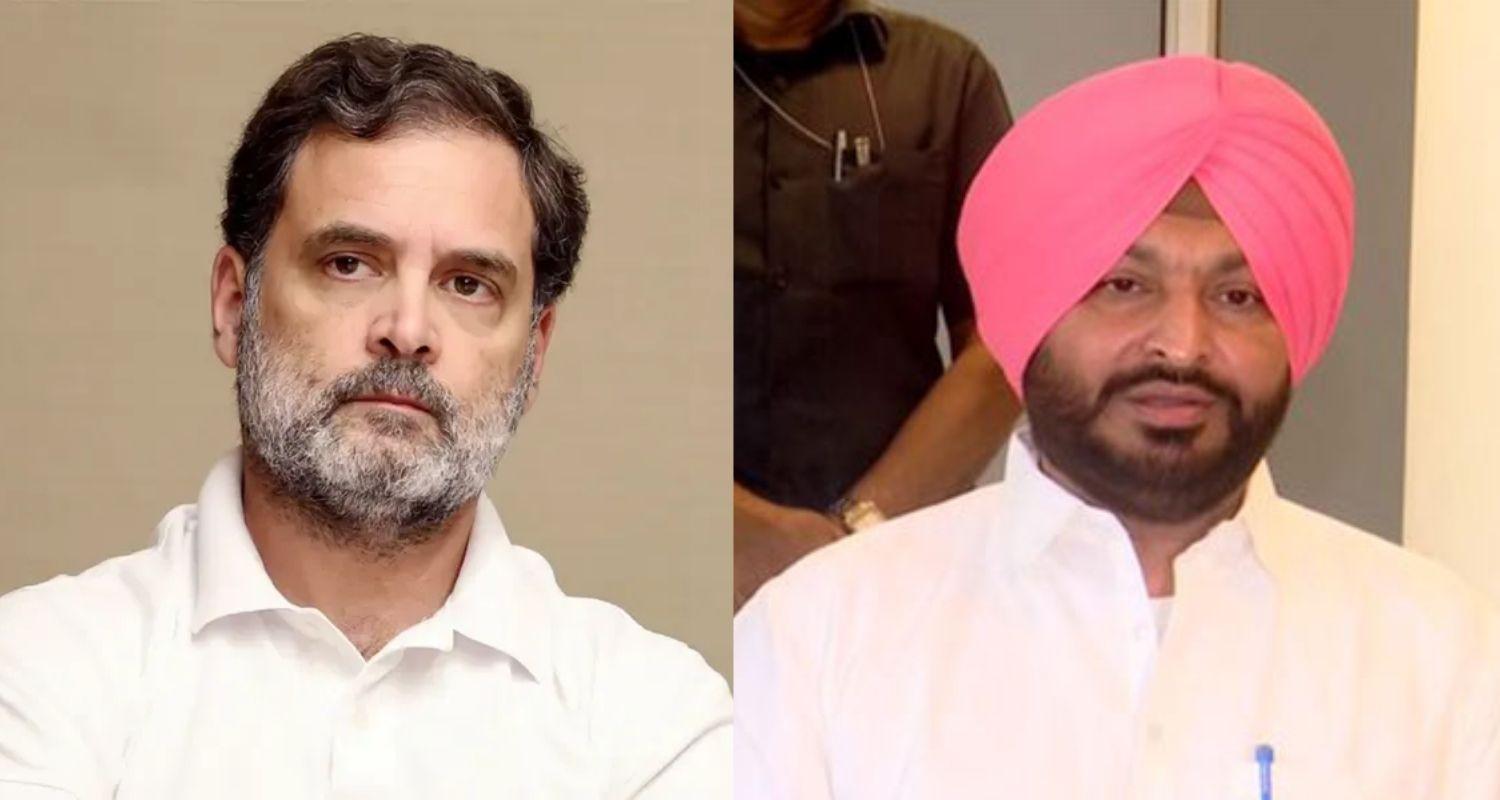
Congressmen across the country are outraged over one of their former colleagues, Ravneet Singh Bittu, now Minister of State in the Railways, describing Rahul Gandhi as an “enemy of the nation”. It started with Gandhi describing him as a “traitor”, which in itself was in utter bad taste. The way Gandhi described him as a traitor, was unbecoming of him (Gandhi), who is the Leader of the Opposition in the Lok Sabha. Bittu had indeed left the Congress and joined the BJP, but switching parties is part of democratic politics. That does not make anyone a traitor.
Gandhi was leading a protest on the stairs of the Parliament when Bittu passed by. Gandhi tauntingly addressed him as “traitor friend”. Not to be cowed down, Bittu retorted, describing Gandhi as the “enemy of the country”. The scene appeared to be not from outside the Parliament, but from a college campus where the ringleader of a group of students tries to bully another student from a different group. There was nothing gracious or jovial about it. It was sort of a bullying act, unbecoming of the Parliamentarians.
It is a fact that Bittu was specially picked up by Gandhi in 2009 to contest from Anandpur Sahib Parliamentary constituency in Punjab and he won. Since then, Bittu never looked back and won consecutively two more Parliamentary elections. In 2014, after he was denied the ticket and replaced by Ambika Soni, he was shifted to Ludhiana from where Manish Tewari had declined to contest due to ill health. He again won in 2019. However, before 2024 General Elections he switched over to the BJP and contested on the party ticket but lost to Punjab Congress president Amarinder Singh Raja Warring by about 20,000 votes in a closely contested fight.
It is apparently for this reason that Gandhi described Bittu as a “traitor” that he left the Congress when it had given him so much. However, switching parties is part of democratic process. A leader or a worker is entitled to his discretion to choose a party with which he works. Crores of voters in the country switch over from one party to another party in every election. Does that make them traitors? You cannot take the loyalty of people for granted. That is why Gandhi was not justified in describing Bittu as a “traitor”.
Not just Bittu, the entire Bharatiya Janata Party hit back at Gandhi accusing him of insulting a “Sikh” MP. There of course was nothing religious or racial about Gandhi’s remarks. When he addressed Bittu, he obviously meant Bittu as a person that had nothing to do with his religion. But in today’s world, narratives are weaved out of nothing and the BJP managed to build up a narrative around Bittu’s religious identity and his turban.
Interestingly, Bittu has himself been on record having said he started tying turban only after he was advised by Gandhi to do so. The Congress leaders posted that particular video thousands of times to defend Gandhi. In the process, they also justified Gandhi’s “traitor” barb on him. This again was unjustified and uncalled for. There is a culture across the entire political spectrum when all and sundry go out of the way to “defend” their leader. They not only try to defend their leader, they also ensure that they are “seen to be defending the leader”. That is what the Congressmen did using all available forums to try to prove their leader right in calling Bittu a traitor.
Also read: War of words: Rahul Gandhi calls Ravneet Bittu ‘traitor’
Interestingly, both Bittu and Gandhi have the family history of sacrifice for the nation. While Gandhi lost his father, Rajeev Gandhi and grandmother Indira Gandhi to terrorism for defending and protecting the unity and integrity of the country, Bittu’s grandfather Beant Singh was also assassinated in a suicide bomb blast while he was Punjab chief minister. Both have legitimate and unparalleled claims to family sacrifices for the nation. Bittu’s uncle Tej Parkash and cousin Gurkirat Singh Kotli are both in the Congress. The party has duly recognised and acknowledged the sacrifice of the family for the nation.
For Gandhi, to make such remarks reflect badly on his leadership qualities. He and his supporters are ambitiously aiming and aspiring for him to be the Prime Minister of the country. He has every right to. He also happens to be the “undisputed” leader of the principal Opposition party in the country. But he has to establish his leadership credentials also. And the leaders do not resort to “campus-like bullying” against their political rivals.
As if that was not enough, the entire “Congress brigade” went lock, stock and barrel against Bittu, while glorifying their leader for his barbs on Bittu. Neither Gandhi did himself any good by calling Bittu a traitor, nor the Congress leaders did any good to their leader or the party by joining the course to justify the “traitor barb”.
In the process, the Congress completely deviated from the issue it had taken up against the government in the context of the autobiography of former army chief MM Naravane. When the party had built up so much momentum against the government, its leader went out of the way to derail the issue. After his “traitor” barb on Bittu, Naravane’s issue went to the backburner as the entire media jumped into this controversy.
This actually reflects badly on Gandhi’s priorities and only adds to and reinforces the public perception that he is not really serious about his job and does things in a very casual and careless manner. As the Leader of Opposition he owes it to the nation to carry and conduct himself in a way that people see in him a possible future Prime Minister and not like a ringleader of a group of “careless and carefree” students gossiping on the campus and trying to bully others.



 Follow us