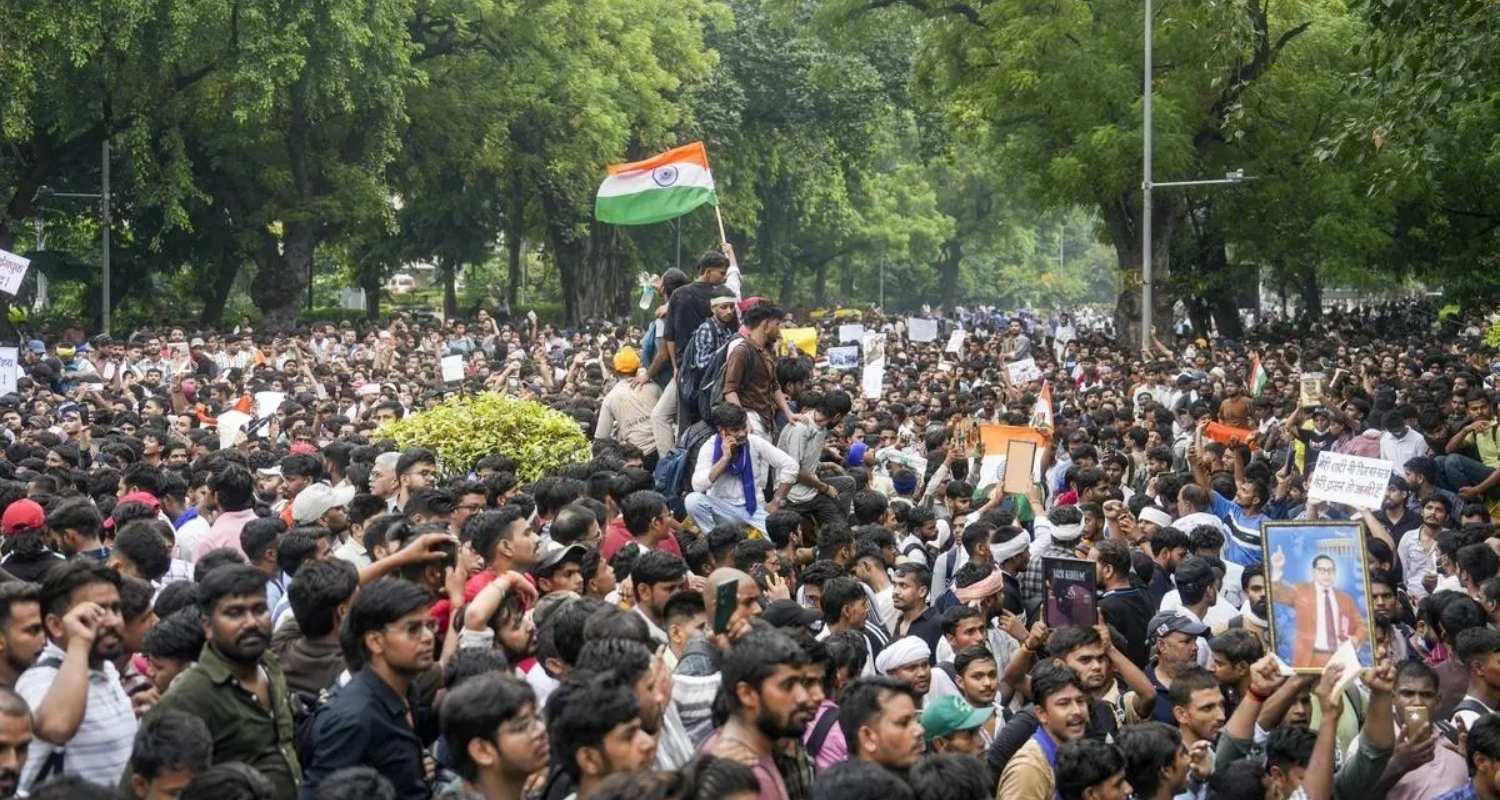
Prime Minister Narendra Modi’s critics are trying to read too much into the Cockroach Janata Party’s protest. It may have led to the Modi government caving in and making Dharmendra Pradhan resign, although multiple factors were involved. However, that does not change the fact that the CJP protest was largely incidental, and there was absolutely nothing ideological or revolutionary about it. The birth of the CJP itself was incidental, having been “provoked” by an innocuous comment made by Chief Justice of India Justice Surya Kant during a Supreme Court hearing on May 15 this year.
While hearing a petition related to the designation of a senior advocate, Justice Kant remarked, “there are youngsters like cockroaches, who don’t get any employment and don’t have any place in the profession. Some of them become media, some become social media, some become RTI activists, some become other activists, and they start attacking everyone.” He also referred to such people as “parasites” while criticising those whom he believed were attacking institutions.
The very next day, Justice Kant issued a clarification, stating that his remarks had been misquoted and taken completely out of context. He said he was not referring to the youth of India in general. According to him, the criticism was directed at people who had entered various professions, including the legal profession, using fake or bogus degrees and were then attacking institutions.
This prompted Abhijeet Dipke, a former Aam Aadmi Party communications consultant who is now a student in the United States, to announce the formation of the Cockroach Janata Party, which quickly attracted millions of followers on Instagram. Soon, he launched an agitation against paper leaks in India and demanded the resignation of Union Education Minister Dharmendra Pradhan, a demand that was eventually met.
Imagine if the Chief Justice of India had never made that remark. Imagine also that there had been no paper leak controversy. Would the Cockroach Janata Party have come into existence, and would there have been any protests? In all likelihood, neither would have happened.
Contrary to the perception being created, the claim that the CJP protests represented the desperation and frustration of Gen Z is misplaced. Had there really been such widespread despair or frustration, it would not have been eased merely by the resignation of a minister. Had the Modi government not responded as quickly as it did, the protest might well have fizzled out on its own.
None of those who joined the protest appeared to be driven by any ideology, motto or mission. The only thing that seemed to bind them together was a strong dislike of Prime Minister Modi, which was reflected in the manner in which many of them openly and repeatedly criticised him.
Assuming that those protesting at Jantar Mantar represented the entire Gen Z population of the country amounts to giving them an exaggerated importance. The protesters themselves did not appear to be clear about what exactly they wanted from the movement. Had they been so, they would not have spent so much time targeting the Prime Minister personally.
In all likelihood, Sonam Wangchuk realised that he had aligned himself with a group that was not serious about its objectives. That may be why he stepped back and chose to end his fast on time, before matters went too far.
The opposition parties are understandably buoyant because, for the first time, Prime Minister Modi was compelled to drop one of his ministers. Earlier, junior minister M.J. Akbar had also resigned, though under very different circumstances following allegations of sexual harassment raised during the #MeToo movement.
Yes, Modi did retreat. That was apparently because of concerns that the agitation could intensify, especially after opposition parties began openly backing the students and extending support to them. For the opposition, it was a cathartic moment. What it had failed to achieve over the last 12 years, a disparate group of young people, without any clear ideology or purpose, managed to achieve. Yet that remains little more than a consolation. In a way, it was also the opposition’s loss, as it ceded political space to the CJP.
Despite lacking any binding ideology, mission or guiding principle, the CJP did succeed in claiming a ministerial scalp. But that is likely where its influence ends. It was little more than a flash in the pan.
Modi’s critics may derive satisfaction from seeing him bow to public pressure, but in the long term he faces no serious challenge from such movements. He retreated to contain a situation that he apparently feared could spiral out of control. This appears to have been an exception, and there is unlikely to be a repetition of it.



 Follow us