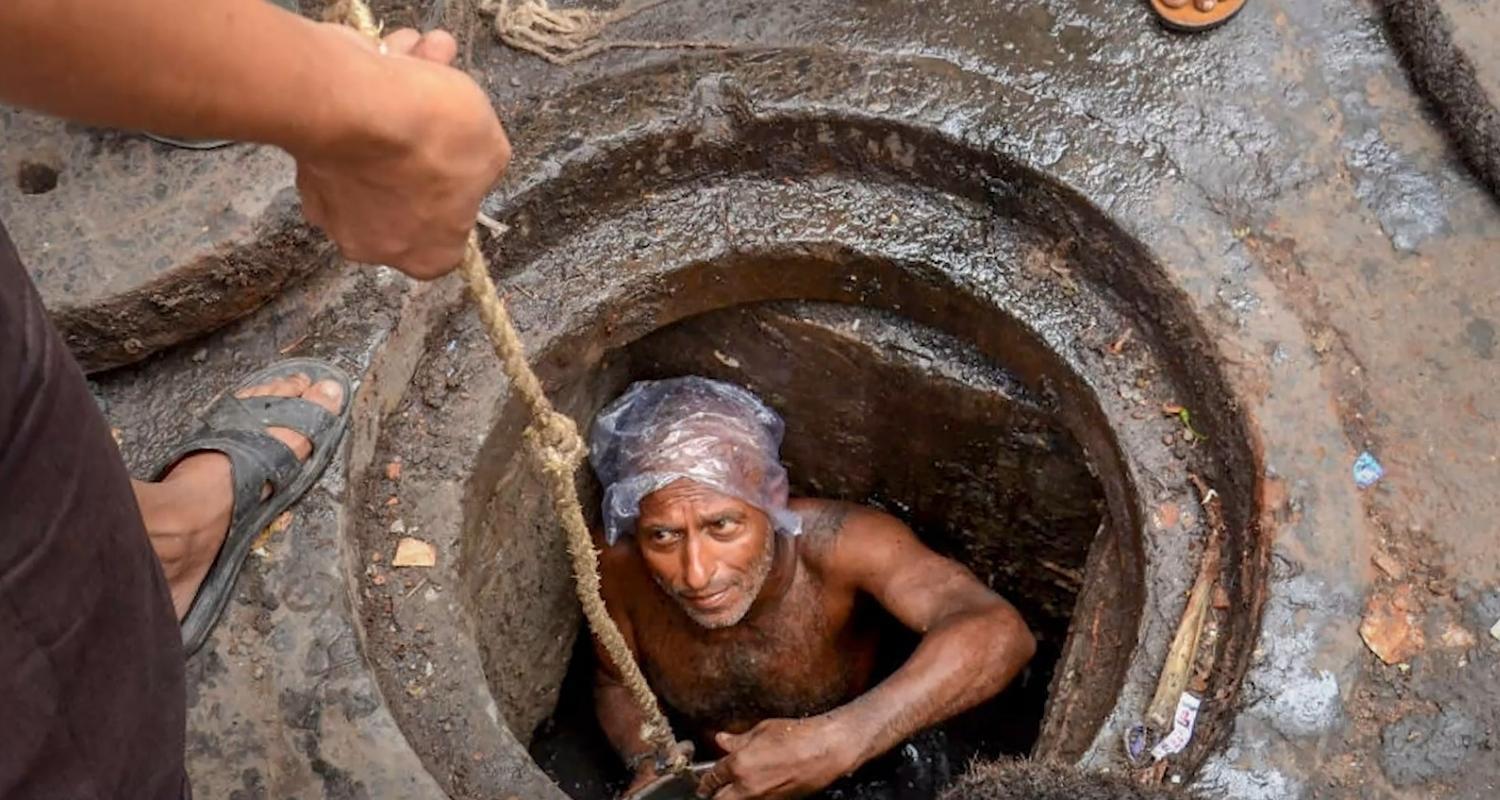
For any problem to cease, it first has to exist; but before any of that happens it foremost has to be acknowledged. The plight of sanitation workers and manual scavengers in India, being an unsettling case in point. At least 622 sanitation workers died in sewers and septic tanks across India in the past 9 years. As many as 52 families of these victims received zero compensation from the authorities. If the government data presented in the Parliament in March of this year is anything to go by, the plight of sanitation workers in India is as abysmal as ignored; the numbers as frightening as telling.
The data was furnished in response to a question, posed by Samajwadi Party MP Iqra Choudhary, to the Ministry of Social Justice and Empowerment, on sewer deaths and rehabilitation of manual scavengers. While the Minister of State for Social Justice and Empowerment Ramdas Athawale stated that a “fresh survey” under the Manual Scavengers Rehabilitation Act, 2013 found “no manual scavengers” in any district across the country, activists and non-government sectors strongly differ. However, the ministry also states that 58,58,098 manual scavengers have been identified during two surveys conducted in 2013 and 2018.
In 2025, the Dalit Adivasi Shakti Adhikar Manch (DASAM) while sharing data on manual scavenging-related deaths in the country, said in a statement, “At a time when the government claims that manual scavenging has been eradicated, the ongoing and preventable deaths of sewer and septic tank workers across the country reveal a starkly different reality, marked by impunity, systemic caste-based discrimination, economic exploitation and institutional neglect.”
While calling for immediate registration of FIRs and independent judicial inquiries, the organisation stated that 116 workers engaged in manual scavenging had died in 2024, and 158 in 2025.
Terming the practice and plight of workers as a “deep failure to protect the most vulnerable members of society”, the DASAM sought adequate compensation, rehabilitation of workers and revocation of licenses of independent contractors and agencies employing the service.
Practice continues under new labels, technical loopholes
First banned in India in 1993, manual scavenging came under the ambit of a comprehensive legal framework in 2013 with The Prohibition of Employment as Manual Scavengers and their Rehabilitation Act. The act makes not just the act legally prohibitory but the rehabilitation of such workers mandatory. However, legality and reality often paint two different pictures, with the practice still commonplace in several pockets of the nation.
Also read: Sewer deaths: HHRC raps authorities for lax probe
The ambiguity around the definition partly stands in the way of eradication of the practice. The technical definition of manual scavenging, “people who handle human waste in spaces such as insanitary latrines” is too narrow to include septic tanks and sewage cleaners. Such cleaning is categorised as “hazardous cleaning” and their deaths as “accidents.” The social issue becomes more layered as the caste-wise data of such workers is not maintained while most of them are hired on contract making it easier for the authorities hiring them to not claim responsibility and categorise their death as simply accidents. The government denies that manual scavenging is a caste-based or even a caste predominant occupation.
Let alone any semblance of likeness between official and non-official figures, there is little agreement between two government figures on how many people are engaged in manual scavenging. In August of 2024, the Ministry of Social Justice and Empowerment, in its reply to Lok Sabha MP Shashi Tharoor seeking details on the issue, replied that as of July 31, 2024 only 732 out of 766 districts in India reported themselves as manual scavenging free. In the same year, a little earlier, in its written reply to Rajya Sabha MP Saket Gokhale, the ministry had said, “there is no report of the practice of manual scavenging in the country in the last five years.”
In March of 2022, MP Dushyant Singh sought a response from Athawale about the state-wise number of deaths due to manual scavenging in the last five years and compensation provided to the families, to which the ministry replied that “not a single death had taken place due to manual scavenging in the said period.” The statement drew widespread ire from sanitation workers, including Dalit rights activist and Safai Karamchari Andolan founder Bezwada Wilson called the government’s stance an insult to the families of manual scavengers.
The deaths cited by activists and NGOs have often been dubbed as “accidental deaths” due to hazardous cleaning of sewer and septic tanks. The figures vary widely; the reality remains the same. At a panel discussion held, in Karnataka in April this year, as a part of state level consultation related to the welfare of Scheduled Tribes and Scheduled Castes, speakers highlighted the reality of manual scavenging still being deeply rooted in caste hierarchies, with dominant communities imposing work while making the workers believe they have no alternative livelihoods. The workers bear the physical and psychological brunt of the labour. “A manual scavenging-free India is a blatant lie,” said the activists and the speakers at the panel discussion.
In 2023’s budget speech, FM Nirmala Sitharaman said, “All cities and towns will be enabled for 100 per cent transition of sewers and septic tanks from manhole to machine hole mode.”
Safai Karamchari Andolan called the initiative “Manhole to Machinehole” yet another instance of sloganeering. “All the noise about mechanical cleaning of sewers and septic tanks neither has any accountability nor transparency,” said the organisation in a statement.
As Bezwada Wilson once said, while calling out the process, how charges brought under ‘negligence’ or ‘accident’ trivialises the issue. It is a murder and should be treated as such. It is inarguably a systemic murder.



 Follow us