Legendary and founder Prime Minister of Singapore, Lee Kuan Yew famously said once, “I do not believe that democracy necessarily leads to development.” He was of the firm belief that good governance and economic development should come before the western-style “liberal democracy”. He also drew parallels between China and India saying, China has outperformed India because it started with a more “disciplined society” and a government able to take “difficult decisions”.
There cannot be more appropriate observation than this. If India has lagged behind, it is because of “too much democracy”, where at times, the unelected force their way over the elected ones.
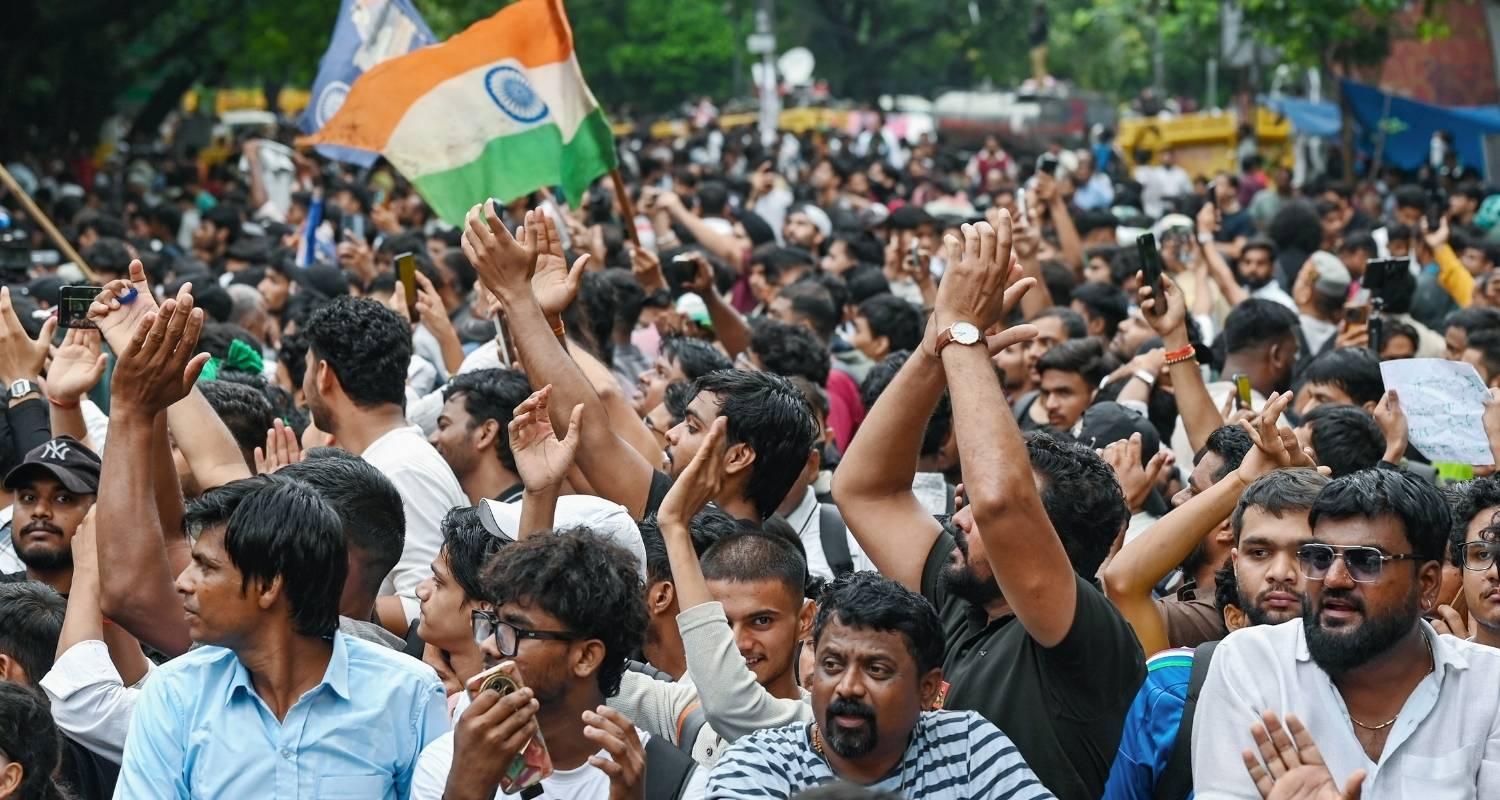
Take the example of the ongoing protests at Jantar Mantar in the national capital. A newly formed political party, “Cockroach Janata Party” has been demanding the resignation of Union Education Minister Dharmendra Pradhan over NEET exam paper leaks.
Whether Pradhan should be held accountable or not is a separate question, but what locus standi does a group of people have to hold the national capital to ransom. And when the government intervenes, it is accused of dictatorship and using brutal force. While such things are out of question in China, even in liberal democracies of the west, such nuisance is not allowed.
Allowing dissent is definitely an important feature of democracy. But no government can allow chaos and anarchy to be let loose in the name of “dissent”. Dissent loses its moral authority the moment it starts turning into blackmail and violence. What is the point and the purpose of marching to the parliament? You have a demand that the minister should resign, although this is not even justified, you are within your rights to put it forth. If the resignations and other demands have to be enforced by protests and blackmail, what is the purpose of having a well-ordered democratic government in place?
It is not happening for the first time. Fifteen years ago, Anna Hazare and Arvind Kejriwal led similar protests in Ramlila Maidan, Delhi. They were supported by the Bharatiya Janata Party. Rather, it was a BJP show and Hazare and Kerjiwal were just masks for the anti-government protests. And imagine what was the issue of protests; corruption charges against a government headed by Dr Manmohan Singh, an erudite scholar, eminent economist and a man of high and incorruptible integrity. Yet a narrative was built up that he was heading a corrupt government. This is not to suggest that everyone in the government was as clean as Dr Singh. There were many rogues in the government.
Also read: Nipping democratic crisis in the bud
Social media had just started making its entry. The limited reach it had, was extensively used by the organisers, patrons and promoters of the protests.
One of the main charges against the government was the loss of Rs 1.75 lakh crores suffered by the government while selling the 2G spectrum. This was purely a speculative figure.
Later the courts concluded that the actual loss was just about Rs 38,000 crores and that loss was for technical reasons and not because anyone had pocketed any commissions. But the propaganda was so powerful that the Congress-led UPA government was “damned” to be the most corrupt government, despite the fact that it was headed by someone like Dr Manmohan Singh.
The BJP, which was in opposition at that time and had lost two consecutive General Elections, was desperate to destabilise the UPA government. With massive manpower comprising lakhs of RSS volunteers always at its disposal, it not only shook the government, but eventually defeated it in the General Elections held two years later.
While the BJP had lost two consecutive General Elections in 2004 and 2009, the Congress has lost three—2014, 2019 and 2024. The party seems to be repeating the BJP script of 2011-12. Like the BJP supported the Anna movement in 2011-12, the Congress and the other opposition parties are trying to support the CJP protests.
This is pure opportunism by both the BJP in 2011-12 and the Congress-led opposition now. These parties with mass base and substantial electoral strength are allowing those who neither have a party structure nor have ever contested an election, to occupy the political space without any accountability. In the process the institution of democracy risks being damaged. If the fate of the ministers is to be decided through public protests what is the purpose of having elections and a parliament and an elected government.
Political parties across the board must engage with each other and have a minimum understanding that chaos and anarchy must not be allowed and encouraged at any cost. Occupying public places, blocking highways and railway lines cannot be anybody’s democratic right. These are criminal acts of holding people to ransom and must be dealt as such.



 Follow us