Tamil Nadu is the only state in the country right now which has continuously elected and been governed solely by regional parties. For more than six decades, the state has not allowed any national party to win elections there. No wonder its politicians not only try to capitalise on and exploit parochial and xenophobic tendencies, but also encourage them.
It is in the same spirit and context that Chief Minister M K Stalin has raised the bogey of “federalism” ahead of the ensuing Assembly elections in the state. Given his ‘not so good’ relationship with the Bharatiya Janata Party government at the Centre, his government in Tamil Nadu has consistently opposed various central policies in the name of federalism. Be it resistance to the Hindi language or opposition to NEET, Stalin has always tried to make political capital out of these issues.
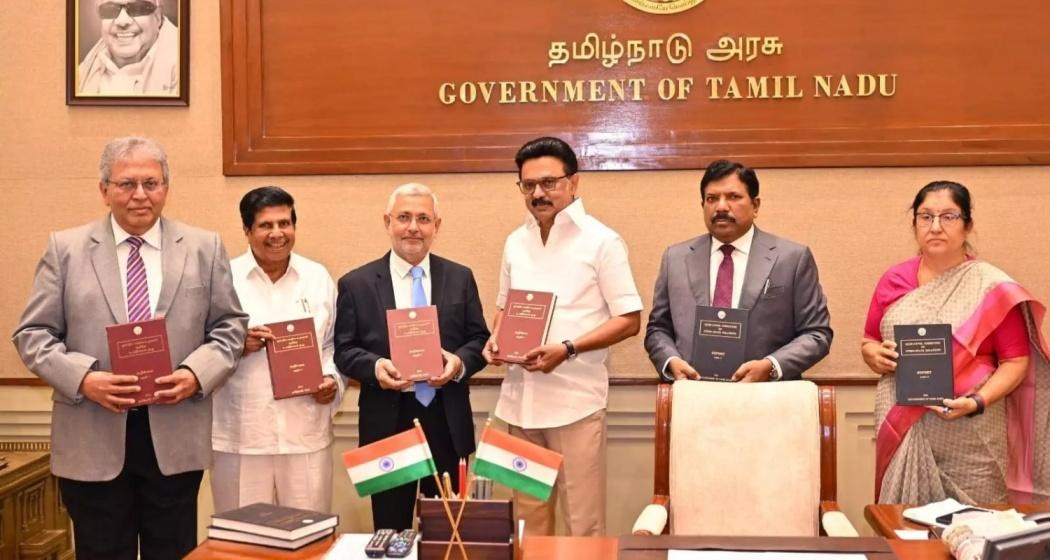
Stalin had set up a high-powered committee to examine state-Centre relations, headed by retired Supreme Court judge Justice Kurian Joseph. The
committee has submitted its report and expressed concern over what it believes is the weakening of federalism in India. The report suggests that “Indian federalism now requires a structural reset comparable in ambition to the economic reforms of 1991”. This is a completely misplaced and unacceptable parallel.
Since the BJP-dominated NDA government has been in power at the Centre since 2014, it is perceived to be “over-centralising” power and authority and “weakening” the states. The BJP has always espoused the idea of a “strong Centre”. Its unambiguous policy on Article 370, which provided special status to the erstwhile state of Jammu and Kashmir and nourished separatist tendencies there before its abrogation in 2019, is cited as an example of the party’s pursuit of a stronger central authority.
However, it was not the BJP but the framers and founding fathers of our Constitution who favoured a more centralised polity with a stronger Centre. There was a historical reason for that. Whenever India’s central authority weakened, it was attacked and conquered by foreign invaders, leading to political instability. Even today, a weak government at the Centre can result in instability and its consequences.
Also read: DMDK joins DMK-led alliance, blow to AIADMK-BJP front in TN
Interestingly, Tamil Nadu under M K Stalin appears to be the only state raising fundamental questions about the existing Centre-state constitutional arrangement. While West Bengal Chief Minister Mamata Banerjee and some other opposition-ruled states have expressed resentment over alleged “discrimination” from time to time, they have not questioned the constitutional framework itself.
The Constitution clearly spells out the separation of powers between the Centre and the states, including the Union, State and Concurrent Lists. The framers sought to ensure clarity and minimise ambiguity. The arrangement has worked well so far. India remains a unified nation despite multiple challenges.
There have been occasional voices alleging a “weakening of the federal structure”, notably from the Shiromani Akali Dal in Punjab, but no political party has aggressively pursued structural change. Even the Akali Dal has typically raised the issue during elections. Stalin has done so more methodically by constituting a high-level committee headed by a retired Supreme Court judge.
It is easy to allege that the “federal structure has been weakened”, but far more difficult to substantiate. There has been negligible use of Article 356, which was misused in the past to dismiss elected governments. It is almost forgotten now. There is hardly any interference in the functioning of state governments by the Centre. Where, then, is the evidence of weakening federalism?
The Centre must necessarily be stronger than the states. Even in the United States, despite its pronounced federal structure, presidential authority remains overriding in key matters. Federalism does not mean a weak central authority. Moreover, the central government in India is not an autocratic dictatorship. It derives its authority from Parliament, elected by the people across states, including Tamil Nadu.
If “structural resetting” of federalism implies revisiting constitutional provisions, then why selectively review only one aspect? If some have concerns about federalism, others may have issues with different provisions. Constitutional review cannot be selective to suit political convenience. Such tendencies deserve to be addressed at the outset.



 Follow us