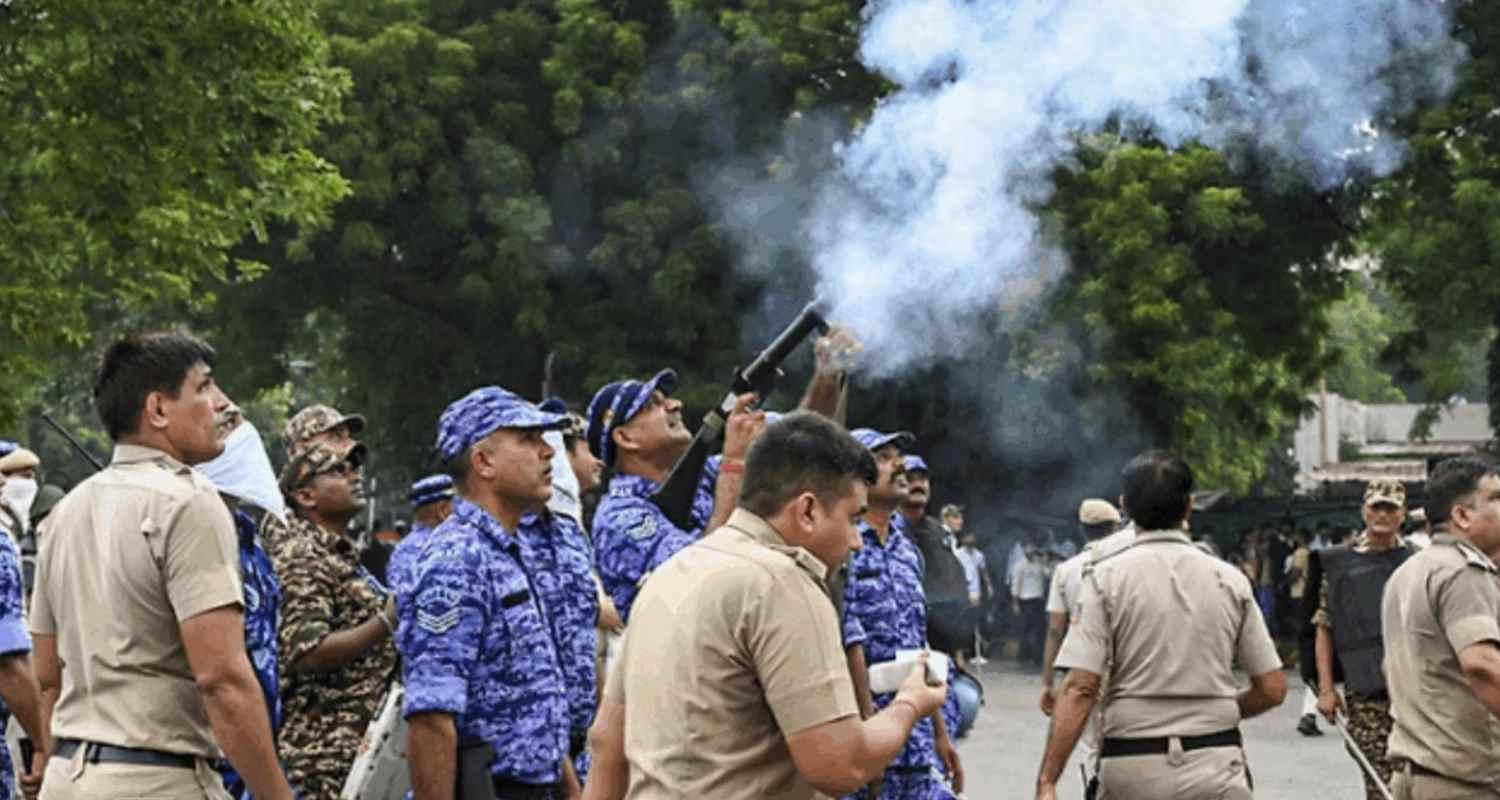
The Supreme Court on Thursday indicated that it was willing to examine the issue of the use of pellet guns for crowd control, but suggested that a petition seeking an outright ban on metallic pellets should instead seek the framing of a protocol governing their use.
A bench led by Chief Justice of India Surya Kant and Justice Joymalya Bagchi was hearing a public interest litigation (PIL) filed by former IPS officer Yashovardhan Azad and two other persons who suffered pellet injuries during the July 20 ‘Sansad Chalo’ protest over the NEET paper leak.
The Supreme Court also directed the Centre to preserve ammunition log of the Rapid Action Force (RAF) deployed at Jantar Mantar during the students’ protest. It further asked the Delhi government to ensure medical treatment to the injured petitioners or other similarly placed individuals.
The petition seeks directions to ban or decommission the use of wholly or partly metallic kinetic projectiles fired from pump action rifles or Projectile Action Guns (PAGs) by law enforcement agencies for crowd control.
During the hearing, Chief Justice Surya Kant suggested that the petition be modified to focus on regulating the use of pellet guns rather than seeking an outright prohibition. “In light of the alleged excessive use, your prayer should be that the court lays down a protocol regarding their use,” the Chief Justice observed.
Justice Joymalya Bagchi also advised the petitioners to amend the plea to enable the court to examine the existing legal framework governing the use of such weapons. “Some changes need to be made in your prayers so we can look into the existing norms which the police and forces follow on this issue,” Justice Bagchi said. He pointed out that police rules already permit the use of pellet guns in exceptional circumstances as part of a graded use-of-force policy.
“Police rules allow the use in exceptional circumstances unless you challenge the rules themselves. One of the steps of the graded approach is the use of pellet guns,” Justice Bagchi remarked.
Appearing for the petitioners, senior advocate Vrinda Grover argued that while rubber and plastic pellets are available, the weapons used during the July 20 protest discharged metallic pellets that were later recovered from the bodies of the injured petitioners.
“There can be rubber, plastic and metallic pellets. These were metallic and recovered from the bodies. The nature of the crowd will determine the use as well. Was it a violent mob? No. These metallic pellets were fired,” she submitted.
Justice Bagchi responded that the court was not unwilling to examine individual instances of alleged misuse, but said the petitioners would have to demonstrate why the graded-response policy permitting pellet guns was arbitrary.
“We are not averse to examining the use of pellets in an individual case. You have to show us if the graded response permitting pellets can be allowed when even bullets are used in some situations,” he observed.
During the hearing, Justice Bagchi recalled that an old rule requiring police to fire bullets at the chest to conserve ammunition had once existed before the Calcutta High Court. Solicitor General Tushar Mehta remarked that it “must be some colonial-era” rule, following which Justice Bagchi noted that it had subsequently been struck down. “You have to show us rules where the use of pellets is arbitrary,” the judge told the petitioners.



 Follow us