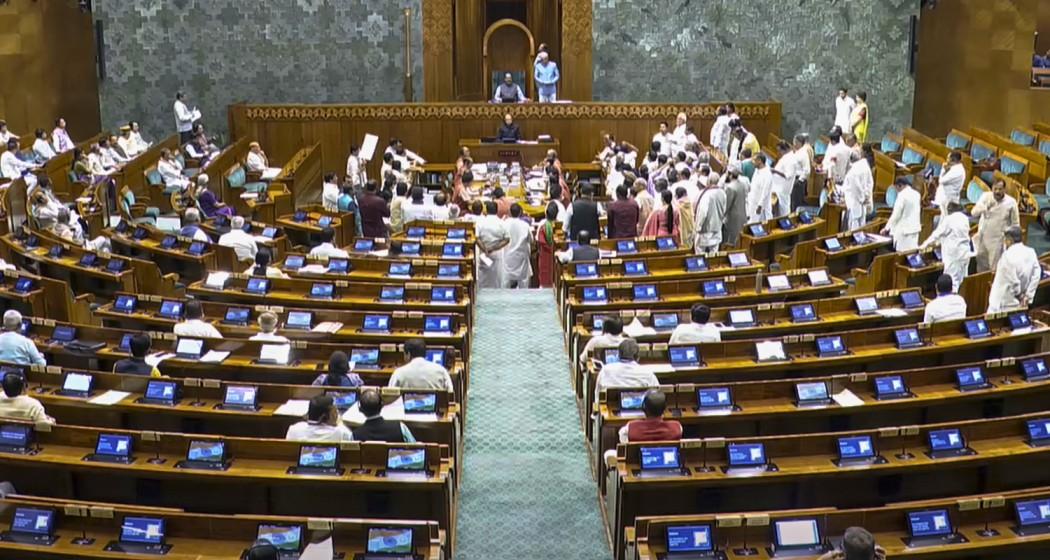
The Lok Sabha on Thursday passed the Taxation and Other Laws (Amendment) Bill, 2026 by voice vote without any discussion as Opposition members continued their protests in the House over police action against demonstrators on July 20.
The Bill, introduced by Finance Minister Nirmala Sitharaman, seeks to amend the Payment and Settlement Systems Act, 2007, the Income-tax Act, 2025, and the Finance Act, 2026. It replaces the Income-tax (Amendment) Ordinance, 2026, promulgated earlier to implement urgent tax measures.
The government said the legislation has been brought in response to evolving geopolitical developments, disruptions in global trade and supply chains, and the need to strengthen India's investment climate. According to the Finance Ministry, the proposed amendments are aimed at enhancing tax certainty, promoting ease of doing business, supporting manufacturing and insulating the domestic economy from external shocks.
A major feature of the Bill is the rationalisation of tax provisions governing eligible offshore investment funds and fund managers. The amendments seek to simplify compliance requirements while retaining key safeguards, with the objective of attracting more global fund management activities to India.
LS clears Bill opening door to charges on UPI transactions
Importantly, the Bill will pave the way for the Centre to notify charges on Unified Payments Interface (UPI) and other electronic payment modes by removing the existing legal restriction that barred banks and payment service providers from levying Merchant Discount Rate (MDR).
The Bill, passed by voice vote without discussion amid Opposition protests, amends the Payment and Settlement Systems Act, 2007, the Income Tax Act, 2025, and the Finance Act, 2026. While it does not immediately impose charges on UPI transactions, it empowers the Central government to specify electronic payment modes on which banks and payment system providers may levy charges in the future.
At present, Section 10A of the Payment and Settlement Systems Act prohibits banks and payment service providers from imposing charges on electronic payment modes prescribed under the Income Tax Act. The amendment replaces this provision, allowing the government to notify one or more electronic payment modes for which such restrictions may no longer apply.
The proposed change is expected to provide greater flexibility in framing a sustainable revenue model for India's rapidly expanding digital payments ecosystem. Banks, payment service providers and fintech firms have long argued that the absence of MDR on UPI transactions has made the system financially unsustainable, with operating costs continuing to rise despite the sharp growth in digital payments.
The government has maintained that the amendment aims to strengthen digital payment infrastructure while balancing the interests of consumers, merchants and payment service providers. Industry observers believe any future MDR, if introduced, is likely to apply only to certain merchant transactions above a specified value rather than person-to-person transfers.
The legislation also extends tax incentives for the electronics manufacturing sector. It proposes extending tax exemptions available to foreign companies supplying capital goods, machinery and tooling to Indian contract manufacturers until the financial year ending March 31, 2041, instead of the earlier deadline of 2030-31. The scope of eligible electronic products has also been widened to include laptops, tablets, servers, wearable devices, hearables and related accessories.
To strengthen India's appeal among global investors, the Bill introduces fresh tax exemptions for Foreign Institutional Investors (FIIs) and the Bank for International Settlements on interest income and capital gains earned from specified government securities, subject to prescribed reporting norms.
The proposed legislation also seeks to boost India's diamond trade by granting tax exemptions until March 31, 2041, for eligible foreign diamond mining companies, brokers, aggregators and auction entities selling rough diamonds through notified special zones.
Another amendment removes an existing restriction that denied tax exemption on dividends received by unit holders of business trusts when the special purpose vehicle had opted for the new tax regime.
Besides taxation reforms, the Bill amends the Payment and Settlement Systems Act by empowering the Central Government to notify electronic payment modes on which banks and payment system providers cannot impose charges, while removing outdated references to the Income-tax Act.
The legislation now moves to the Rajya Sabha for consideration before it can become law.



 Follow us