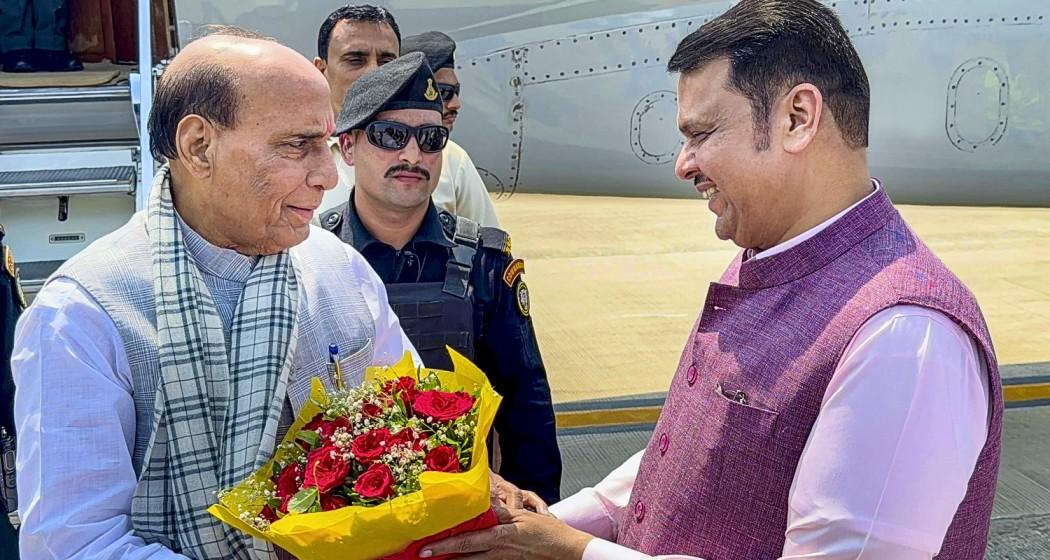
Defence Minister Rajnath Singh on Saturday said India is poised to become the world’s biggest weapons exporter in the next 25 to 30 years, asserting that the private sector would play a crucial role in achieving the goal.
Speaking after inaugurating an ammunition manufacturing unit in Shirdi, Maharashtra, Singh said India, once heavily dependent on arms imports, was rapidly transforming into a major defence manufacturing hub.
“India was considered a weapons importer earlier. No power can now stop it from becoming the biggest exporter in the next 25-30 years,” the Defence Minister said.
Singh underlined the government’s focus on increasing private sector participation in defence production and said the Centre aimed to raise its role in the sector to 50 per cent.
“When the government’s vision and the private sector’s innovation align, the country reaches new heights,” he said.
The minister stressed that private companies were no longer limited to supplying small components to the armed forces.
“Private sector is not just a supplier of nuts and bolts in defence, but also a producer of state-of-the-art weapons systems,” he said.
Singh also called for collective efforts to make India a global hub for munitions manufacturing and defence automation.
The remarks come amid the Centre’s broader push for defence self-reliance under the ‘Atmanirbhar Bharat’ initiative, which seeks to reduce dependence on foreign military imports while boosting indigenous production and exports.
Maharashtra Chief Minister Devendra Fadnavis was also present during the event.
Also read: Rajnath Singh lays foundation of fighter jet infra project
India’s defence now a whole-of-nation effort: CDS
Chief of Defence Staff Anil Chauhan on Saturday said India’s defence preparedness has evolved into a “whole-of-nation approach”, asserting that future wars would increasingly become multi-domain conflicts involving both military and non-military dimensions.
Addressing an event in Maharashtra, General Chauhan said the nature of warfare was changing rapidly and countries could no longer depend solely on conventional military strength to tackle emerging threats.
“The nation’s defence preparedness is now no longer restricted only to the armed forces. It has become a whole-of-nation approach,” he said.
The CDS said future conflicts would involve simultaneous integration of land, sea, air, cyber, space and cognitive warfare capabilities, making coordination across sectors crucial.
“Future wars will increasingly become multi-domain in nature,” he said, adding that preparedness would require participation from the armed forces, industry, academia, scientific institutions and civil society.
Chauhan stressed the need for stronger indigenous defence capabilities and technological self-reliance to deal with evolving security challenges.
He also highlighted the growing role of cyber warfare, artificial intelligence, drones and space assets in modern military engagements.



 Follow us