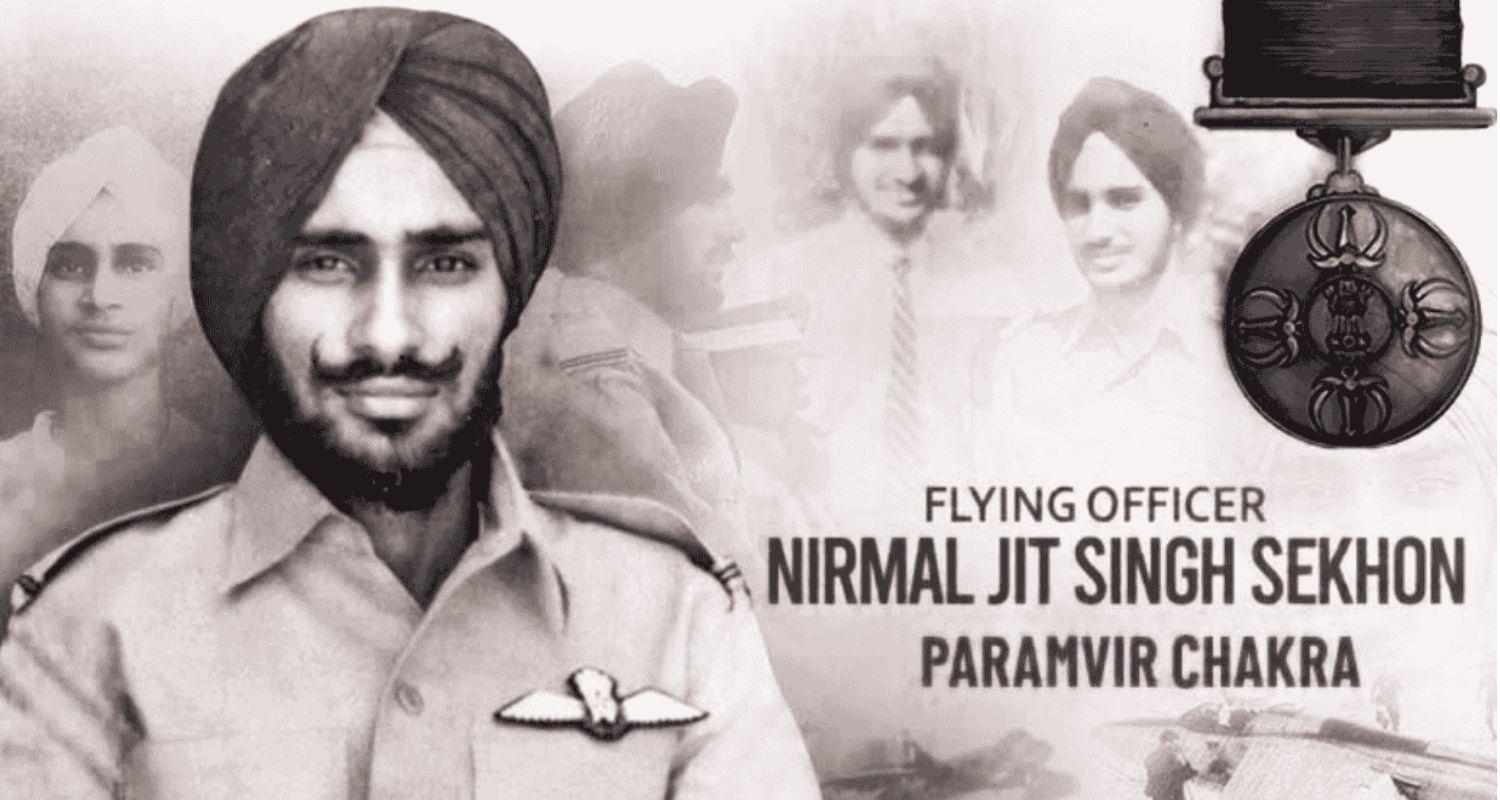
Flying Officer Nirmal Jit Singh Sekhon, the only officer of the Indian Air Force to receive the Param Vir Chakra, India's highest wartime gallantry award, occupies a unique place in the nation's military history. His extraordinary courage during the Indo-Pak War of 1971 made him an enduring symbol of patriotism, sacrifice, and fearless devotion to duty.
Born on July 17, 1945, in the village of Rurka in Punjab's Ludhiana district, Sekhon displayed determination from an early age. As a child, he struggled with a slight stammer, which repeatedly obstructed his lifelong dream of becoming a fighter pilot. Although he cleared the written examination for admission to the National Defence Academy twice, he was rejected by the Services Selection Board because of his speech impediment.
His father, Tarlok Singh, served as a Master Warrant Officer in the Indian Air Force and later received the honorary rank of Flying Officer. Growing up near an airbase, young Sekhon developed an enduring fascination with military aviation. Inspired by stories of Sikh heroes narrated by his parents, particularly the legendary General Hari Singh Nalwa, he dreamt of serving the nation with courage and honour.
Also read: Army Chief makes maiden visit to LoC, reviews security
Even as a child, Sekhon displayed remarkable leadership and bravery. He organised mock military parades with village children, carrying a homemade flag tied to a stick. Recognising his son's enthusiasm, his father bought him an air gun, with which he became an excellent marksman. His fearless temperament was evident at the age of eight when he chased and killed a wild cat that had attacked the family's hens, refusing to retreat despite the danger.
Watching fighter aircraft take off from the nearby airbase strengthened his ambition to fly. After completing his matriculation, he continued his studies while working to overcome his speech difficulty. Following the expansion of the Indian Air Force after the 1962 Sino-Indian War, he applied for pilot training without informing his father. This time he succeeded, completing his training and graduating as a fighter pilot in 1967, fulfilling the dream he had cherished since childhood.
Sekhon often told his father that if war ever came, he would never turn his back on the enemy. Confident in his flying skills, he declared that he would shoot down at least two enemy aircraft if given the opportunity. Besides flying, he possessed exceptional mechanical aptitude and could expertly operate cars, motorcycles, scooters, and tractors. A keen reader of military history and aerial warfare, he admired the legendary fighter pilots of the Second World War and aspired to emulate their courage.
His defining moment came during the Indo-Pak War of 1971. On the cold morning of 14 December 1971, Flying Officer Sekhon was on operational duty at Srinagar Air Base when six Pakistan Air Force F-86 Sabre fighters launched a surprise attack. As bombs exploded across the runway, he made a decision that would immortalise his name in Indian military history. Without waiting for formal clearance, he scrambled into his Folland Gnat fighter and took off to defend the airfield against overwhelming odds.
Displaying extraordinary flying skill, lightning-fast reflexes, and exceptional courage, Sekhon engaged the six enemy fighters single-handedly. He shot down one Sabre and then destroyed a second. Calmly reporting his success over the radio, he informed ground control that he was pursuing another enemy aircraft. Despite repeated warnings that his own aircraft had sustained serious damage and instructions to disengage, he refused to retreat.
True to the promise he had once made to his father, Sekhon continued fighting against overwhelming odds. His determined resistance forced the remaining Pakistani aircraft to break away from their attack. However, his Gnat had suffered critical damage during the fierce engagement.
Moments later, the aircraft crashed, and Flying Officer Nirmal Jit Singh Sekhon laid down his life in the service of the nation.
For his conspicuous bravery, exceptional flying skill, and supreme devotion to duty, he was posthumously awarded the Param Vir Chakra, becoming the only officer of the Indian Air Force to receive India's highest wartime gallantry decoration.
Standing over six feet two inches tall, Sekhon possessed an impressive athletic build, but it was his courage rather than his stature that made him truly great. His sacrifice remains an inspiration to generations of Indians and a shining example of unwavering patriotism.
His family's grief reflected the personal cost of national heroism. Relatives recalled that long after his martyrdom, his grandmother would gently rock the empty cradle in which she had once sung lullabies to her beloved grandson.
On August 3, 1973, in a ceremony at the Central Sikh Museum in Amritsar, the Chief of the Air Staff presented Sekhon's portrait to the museum as a tribute to his immortal sacrifice.
By Brij Bhushan Goyal



 Follow us