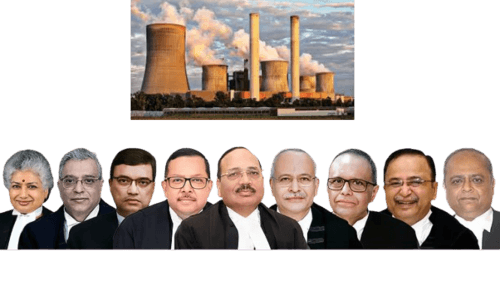
The Central government on Tuesday told the Supreme Court that excessive expansion of the definition of ‘industry’ has serious consequences, as it can burden employers and deter private players from entering the market.
The submission was made by Central government's senior-most law officer, Attorney General for India (AG) R Venkataramani, before a nine-judge Constitution Bench that began hearing a case on Tuesday, regarding the scope of definition of 'industry' under the Industrial Disputes Act, 1947.
The Bench of Chief Justice of India (CJI) Surya Kant, along with Justices BV Nagarathna, PS Narasimha, Dipankar Datta, Ujjal Bhuyan, Satish Chandra Sharma, Joymalya Bagchi, Alok Aradhe and Vipul M Pancholi, is examining the correctness of the court's seven-judge Bench judgment in Bangalore Water Supply & Sewerage Board (BWSSB) v. R Rajappa & Others, which was pronounced in 1978.
In that case, the top court had ruled that the term ‘industry’ has to be given a wide interpretation and every profession, regardless of profit motive was included within ‘industry’. AG Venkataramani said the courts should not substitute their own social or economic philosophy for legislative judgment.
"Industrial law must balance both sides, preventing exploitation of workers but also ensuring that employers are not placed in a position where they cannot function, as growth of industry is itself a matter of public good. An over-expansive interpretation can deter private enterprise in a country where employment opportunities are scarce, and even professions based on skill, talent and intellectual attainment risk being unnecessarily brought within the fold of 'industry’. We must be cautious not to fall into expansionism driven by ideology; courts should not substitute their own social or economic philosophy for legislative judgment," the AG said.
Referring to the repeal of the Industrial Disputes Act, Venkataramani said the Parliament has already intervened to restructure a rather vague and somewhat amorphous definition under Section 2(j)."It would be difficult to ignore that legislative intent. The court itself, from Bangalore Water Supply onwards, has struggled with this clumsy and expansive definition, attempting to give it meaning consistent with the anti-exploitation object of the Industrial Disputes Act, but that exercise has its limits. There is also a recognised need in law to retain a certain degree of openness in definitions, allowing them to evolve over time, but that does not justify unbounded expansion," he said.
Venkataramani further submitted that collective bargaining was very popular during earlier times and the same is now covered by policy and statute. An over-expansive interpretation can deter private enterprise in a country where employment opportunities are scarce. Additional Solicitor General (ASG) KM Nataraj, representing the State of Uttar Pradesh, also argued against expansive definition of industry. "There is a need to balance the competing interests of employer and employee. We cannot give sweeping definition here," Nataraj said.
Accordingly, every profession regardless of profit motive was included within ‘industry’. However, there has since been a slew of cases calling for a more restrictive interpretation of industry and limiting it to manufacturing units. In this context, senior advocate CU Singh today said the definition being considered by the court no longer exists. CJI Kant said the issue stands ‘shortened’ now. “It is now for transitional matters which originated at the time the old Act was there,” Singh said.
Senior advocate Indira Jaising argued that any judgment rendered by the court in this case will have an impact on the new law. There will be an unintended overlap, she submitted. CJI Kant said this aspect can be clarified and any new challenge will be independently dealt with. “A word of caution can always be put that this interpretation relates to the law as it used to be then,” the CJI added.
Justice Datta highlighted that the five-judge Bench had not disclosed why had prompted it to refer the matter to a larger bench. Justice Datta added that it needs to be examined whether the reference was valid. Justice Nagarathna said the judgment came in the 1970s and then there were reforms in 1991, focused on liberalisation, privatisation and globalisation of Indian markets.



 Follow us