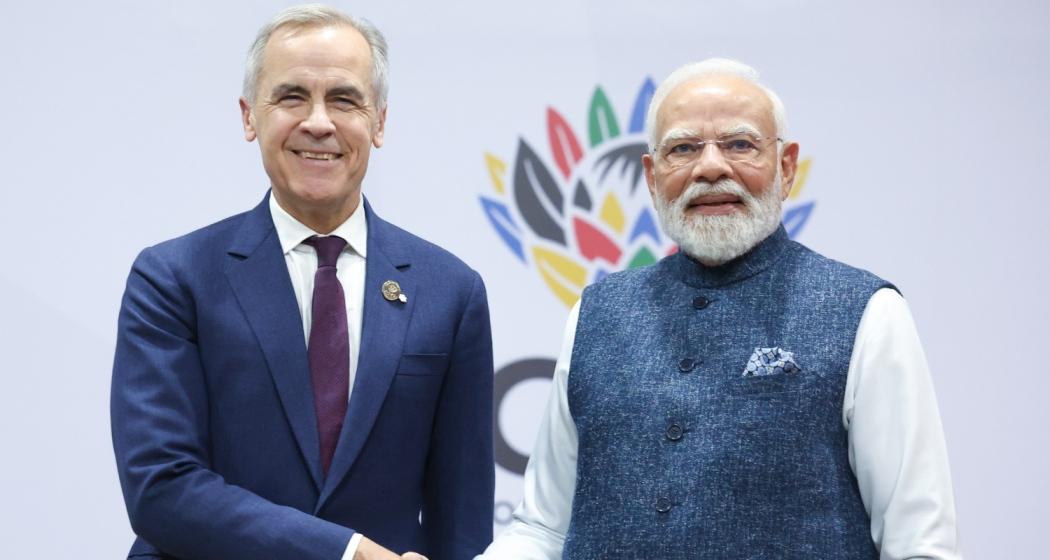
Canadian Prime Minister Mark Carney arrived in India on Friday for a four-day visit aimed at rebuilding strained diplomatic ties with Prime Minister Narendra Modi and advancing trade diversification efforts.
Carney will spend two days in Mumbai before travelling to New Delhi on March 1 for talks with Modi. Both leaders are seeking to reduce economic dependence on the United States under President Donald Trump, analysts said.
“Both for India and for Canada, the big picture is one of diversification and reducing overreliance on the U.S.,” Vina Nadjibulla, vice-president of the Asia Pacific Foundation, said. “There is definitely sort of a Trump accelerator in play here.”
Since assuming office, Carney has intensified outreach to global partners, including an address at the World Economic Forum in Switzerland last month urging middle powers to counter great power coercion.
The visit comes after years of diplomatic turbulence. Tensions escalated sharply in September 2023 when former Canadian prime minister Justin Trudeau alleged that Canadian security agencies were probing “credible allegations” linking Indian government agents to the killing of Hardeep Singh Nijjar, a Canadian citizen and Khalistan advocate, in June 2023. India rejected the accusation, and both sides expelled senior diplomats.
Also read: Modi, Carney to reset India-Canada ties
Relations further deteriorated in October 2024 after the Royal Canadian Mounted Police accused New Delhi of involvement in violent criminal networks, allegations India denied.
The diplomatic freeze began to thaw when Carney invited Modi to the G7 summit in Alberta in June 2025, where the two agreed to reappoint high commissioners. At the G20 summit in November, they agreed to launch formal trade negotiations covering agriculture, digital trade, mobility and sustainable development.
India has recently concluded major trade agreements, including a landmark pact with the European Union, while Canada seeks to deepen energy and technology cooperation with New Delhi.
India’s High Commissioner to Ottawa, Dinesh Patnaik, said multiple high-level interactions have laid groundwork for renewed engagement. Analysts, however, cautioned that while broad contours of cooperation may emerge, detailed agreements could take time.
Observers note that longstanding differences over Sikh separatism, free speech and strategic positioning remain unresolved. Whether the renewed engagement matures into a durable partnership, they suggest, will depend on sustained political will beyond immediate geopolitical pressures.



 Follow us