


Trending:
Iran war spills into seas
War in West Asia spreads to seas and skies as Iran, Israel and US escalate attacks, disrupting shipping, killing civilians and raising concerns for India’s energy security and diaspora. Follow us
News Arena Network - Tehran - UPDATED: March 5, 2026, 10:16 PM - 2 min read
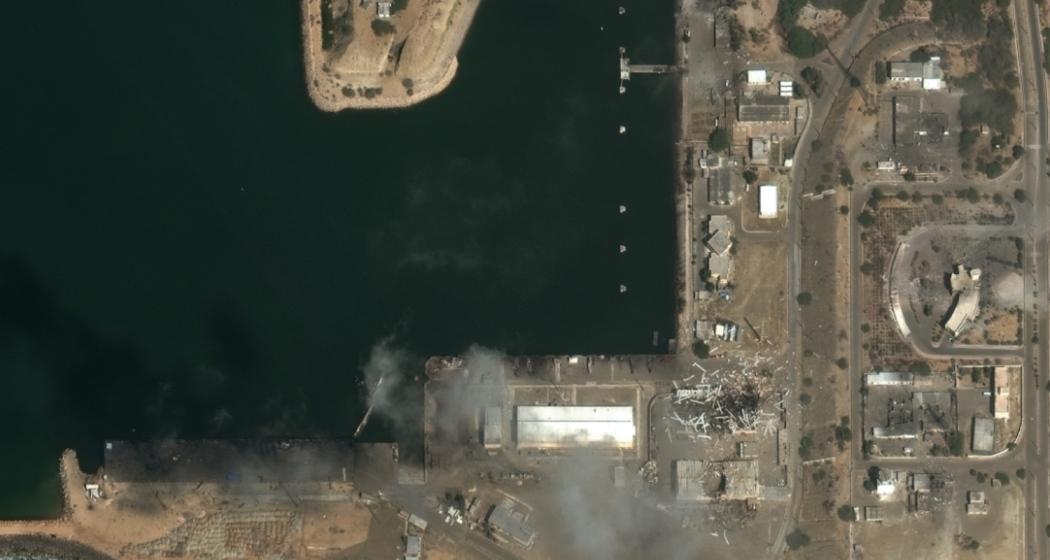
This satellite image provided by Vantor shows a view of damaged Konarak Naval base in Iran on Wednesday.
The war between Iran and the United States-Israel alliance intensified on Thursday, spreading decisively into maritime zones across the Gulf and the Indian Ocean even as missile exchanges, air strikes and diplomatic manoeuvres deepened fears of a prolonged regional conflict.
Six days after the United States and Israel launched coordinated strikes inside Iran that killed Supreme Leader Ayatollah Ali Khamenei, the confrontation has widened from air and land battles to shipping routes and naval assets, threatening global trade arteries and energy flows critical to Asia.
Iran on Thursday launched another wave of missiles targeting Israeli territory and American military bases in the Gulf region. Israeli air defences intercepted several projectiles as sirens sounded across major cities, while Israeli forces responded with new strikes on Tehran and positions linked to the Iran-backed Hezbollah group in Lebanon.
The death toll in Iran from the ongoing war has reached at least 1,230 people, an Iranian government agency said Thursday. Iran’s Foundation of Martyrs and Veterans Affairs offered the toll, saying the figure includes those killed since the start of the strikes across the country, though it did not distinguish between civilian and military casualties.
The conflict is now increasingly centred on strategic waters stretching from the Strait of Hormuz to the eastern Mediterranean, raising alarm over disruptions to commercial shipping and energy supplies. Oil prices have risen sharply amid fears that the conflict could choke maritime routes through which a large share of the world’s crude exports pass.
For India, the escalation carries immediate strategic implications. Nearly 10 million Indians live and work across the Gulf region, while the country depends heavily on West Asian energy supplies transported through vulnerable sea lanes.
New Delhi has intensified diplomatic engagement amid the crisis. External Affairs Minister S Jaishankar spoke with Iranian Foreign Minister Seyed Abbas Araghchi, while Prime Minister Narendra Modi held a conversation with French President Emmanuel Macron on the need for de-escalation and a return to diplomacy.
The government has also warned against misinformation and reiterated that Indian ports are not being used for attacks against Iran, even as the Ministry of External Affairs monitors the safety of Indian nationals across the region.
With naval incidents multiplying and missile attacks expanding across borders, the conflict now threatens to engulf wider parts of West Asia and the surrounding seas.
India steps up diplomacy amid regional crisis
India has intensified diplomatic outreach as the conflict escalates, with External Affairs Minister S Jaishankar holding a telephonic conversation with Iranian Foreign Minister Seyed Abbas Araghchi on Thursday.
In a brief post on X, Jaishankar confirmed the call but did not disclose details of the discussion. The conversation came days after India expressed “deep concern” over the rapidly deteriorating security situation in the Gulf and Iran.
The Ministry of External Affairs has stressed that the safety and welfare of nearly one crore Indians living and working across the Gulf region remains the government’s foremost priority. New Delhi has also warned that the conflict threatens global energy flows and trade routes that pass through West Asia.
India has consistently urged all sides to exercise restraint and resolve differences through dialogue and diplomacy.
Modi, Macron discuss restoring peace
Prime Minister Narendra Modi spoke with French President Emmanuel Macron on Thursday as part of international efforts to prevent the conflict from spiralling further.
Following the call, Modi said both leaders shared concerns about the evolving situation in West Asia and emphasised the need for a return to diplomacy.
“We discussed our shared concerns over the evolving situation in West Asia and the need for a return to dialogue and diplomacy,” Modi said in a post on X.
The leaders agreed to remain in close contact and coordinate efforts aimed at restoring peace and stability in the region. European nations have also begun reviewing military deployments in the Mediterranean as tensions mount.
Also read: India condoles Khamenei death; Misri visits Iran embassy
Sri Lanka weighs action as Iranian vessel seeks entry
Sri Lanka is deliberating its response after a second Iranian vessel sought entry into its waters a day after an Iranian frigate was destroyed near the island nation killing at least 84.
Authorities said the ship is currently positioned in Sri Lanka’s Exclusive Economic Zone but outside territorial waters. The government said it was assessing the situation to safeguard lives and prevent further escalation.
The development follows the sinking of the Iranian frigate IRIS Dena near the southern port city of Galle after an attack attributed to a US submarine.
Sri Lankan authorities recovered dozens of bodies of Iranian sailors from the wreckage, raising concerns about the conflict spilling into the Indian Ocean.
Iran vows revenge after US sinks warship
Iran has issued a stern warning to the United States following the sinking of the frigate IRIS Dena in the Indian Ocean.
Iranian Foreign Minister Abbas Araghchi accused the US Navy of committing an “atrocity at sea” and warned Washington would “bitterly regret” the attack that reportedly killed dozens of sailors.
Iran also launched new missile strikes targeting Israeli and American military positions across the region, signalling that its retaliation campaign would intensify.
The Israeli military, meanwhile, said it carried out large-scale strikes on Iranian missile launch sites and facilities linked to Hezbollah in Lebanon.
The escalation has raised fears of a prolonged military confrontation involving multiple countries.
Iran postpones funeral for Khamenei amid bombardment
Iran has postponed the funeral ceremony for Supreme Leader Ayatollah Ali Khamenei as Israeli and US strikes continue across the country. Iranian officials said the public farewell ceremony in Tehran had been delayed due to security concerns following the bombardment. Authorities announced that a three-day mourning ceremony would be organised once conditions stabilise.
Meanwhile, Iranian officials denied reports that a successor to Khamenei had already been selected by the Assembly of Experts.
The death of the long-serving leader has triggered political uncertainty in Iran even as the country mobilises militarily against Israel and the United States.
IRGC claims hypersonic missile strikes on Israeli targets
Iran’s Islamic Revolutionary Guard Corps said it launched hypersonic missiles and drones against strategic Israeli and American targets under an operation dubbed “True Promise-4”.
According to Iranian state media, the strikes targeted Israel’s defence ministry building and Ben Gurion Airport, while destroying several advanced radar systems.
The IRGC claimed the weapons bypassed US-made missile defence systems deployed in the region.
Air raid sirens reportedly sounded across several Israeli cities as civilians took shelter.
Iran also warned that operations against what it described as “aggressors” would intensify in the coming days.
Two Indians killed in tanker attack near Strait of Hormuz
Two Indian nationals were killed when an oil tanker was attacked in the Gulf of Oman amid the escalating conflict. The vessel, Skylight, was struck near Oman’s Musandam Peninsula, according to maritime authorities. Captain Ashish Kumar from Bihar and crew member Dixit Solanki from Mumbai were confirmed dead, while another Indian sailor from Rajasthan has been reported missing.
Fifteen Indians were among the 20 crew members aboard the tanker, which was flying the Palau flag.
The incident highlights the growing dangers to commercial shipping and the large number of Indian seafarers working in the region.