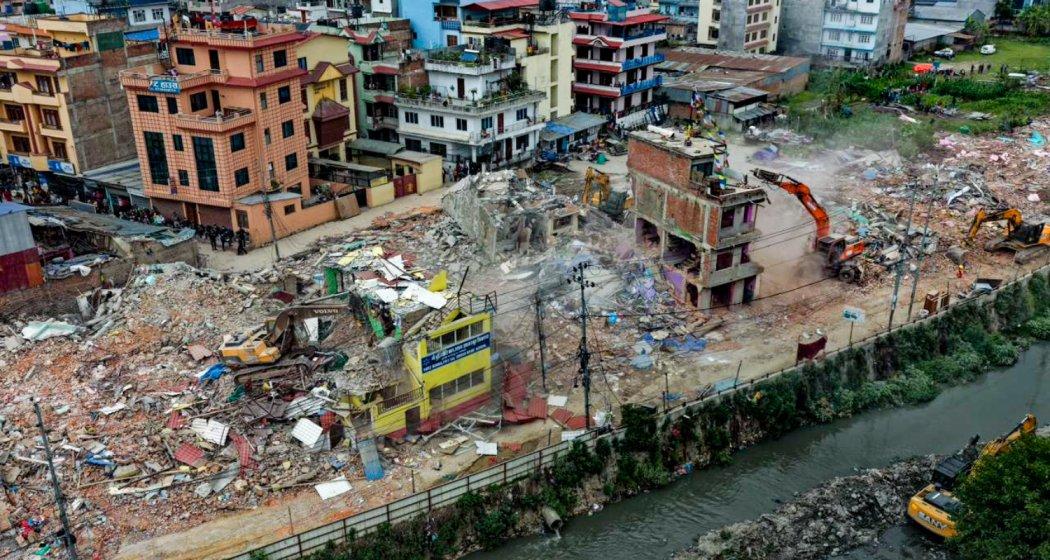
Nepal’s government on Saturday intensified its demolition drive across the Kathmandu Valley, razing hundreds of illegal structures along riverbanks and taking the total number of demolished settlements to around 2,000, even as opposition leaders and activists raised concerns over displacement and lack of rehabilitation.
The operation was carried out in Swoyambhu, Balaju and Dhovikhola areas of Kathmandu, where squatter settlements, including concrete structures built on riverbanks, public and government land, were removed. Thousands of security personnel were deployed to oversee the exercise.
The drive has gathered pace over recent days. On Friday, authorities demolished illegal structures in Teku and Balkhu, while similar operations were conducted last week in Thapathali, Gairigaun and Manohara areas of the capital.
The campaign has drawn criticism from opposition parties, which have questioned the manner of implementation, particularly the absence of adequate notice and alternative arrangements for those affected. Concerns have also been raised over conditions at temporary holding centres and the lack of comprehensive data on landless settlers prior to the demolitions.
Arjun Narsingh KC said the initiative, though necessary from an environmental and urban management perspective, required a more balanced approach. “The biggest question is displacement without alternatives," he said.
“Using bulldozers on citizens who have lived in landless and impoverished conditions for years without ensuring alternative housing is not merely administrative harshness, it is also a failure of the compassionate and humane duty of a sensitive state,” he added.
_26lBM9J3Rt.jpg)
Also read: Nepal Airlines ‘sorry’ for showing J&K as part of Pakistan in map
Shankar Pokharel argued that prior communication with affected communities was essential. He cautioned that the absence of rehabilitation measures before the onset of the monsoon could trigger a humanitarian crisis if thousands remain displaced.
Civil society voices have also weighed in on the issue. Raksha Bam urged Prime Minister Balendra Shah to demonstrate “sympathy” and “compassion” in addressing the concerns of those displaced. She said that in a country where the Buddha was born, governance must be guided by humane considerations rather than rigid enforcement.
The demolition drive has also coincided with reports of distress among displaced residents. An elderly man residing in a squatter settlement in Balkhu allegedly died by suicide after his temporary house was bulldozed on Friday. Police recovered the body from the banks of the Bagmati river.
Accounts from displaced individuals highlight challenges within temporary shelters. Santa Bahadur, a labourer currently housed at a holding centre in Kirtipur, described restrictions on movement affecting livelihoods. “The security guard didn’t permit us to go outside for work and the relatives who want to meet us are also finding it difficult to enter the shelter.
_OMflRsdrPK.jpg)
“As a labourer I have to go out for work for my family but the security guard didn’t allow to leave the shelter,” he said.
The government has maintained that the drive is aimed at reclaiming public land, protecting river ecosystems and improving urban management, but the unfolding humanitarian concerns continue to dominate the debate.



 Follow us