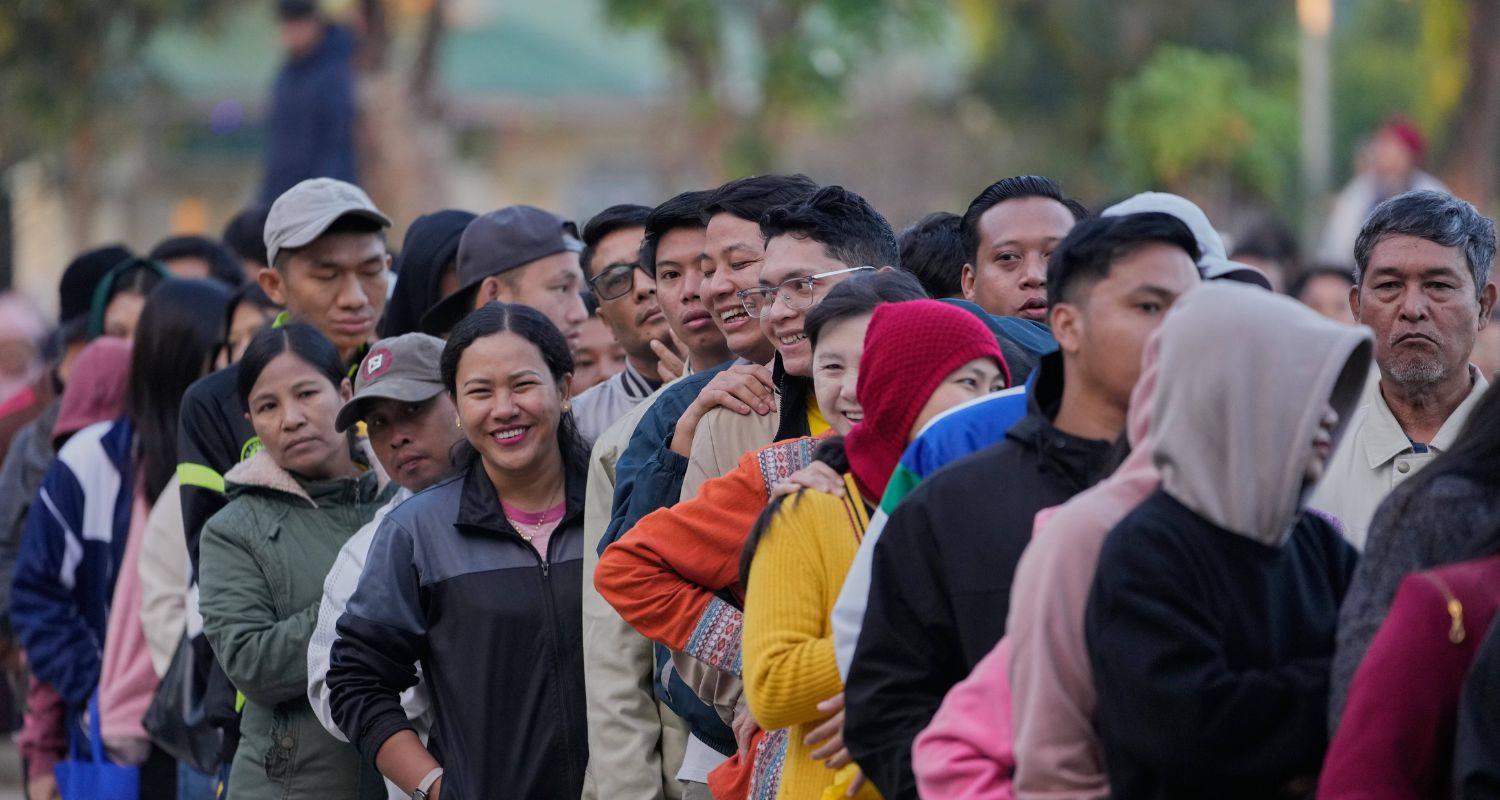
Civil war-torn Myanmar’s public began casting its votes on Sunday for the initial phase of the country’s first general election in five years, which is being held under strict supervision despite the ruling junta touting it as a ‘return to democracy’.
In Yangon, the country’s largest city, Naypyitaw, the capital, and elsewhere, voters were casting their ballots at high schools, government buildings and religious buildings with armed guards stationed outside and military trucks patrolling the streets. On Saturday, election officials set up equipment and installed electronic voting machines, which are being used for the first time in Myanmar.
Meanwhile, former civilian leader, Aung San Suu Kyi, 80, is not participating as she serves a 27-year prison term since her elected government was ousted by the army in February, 2021. Her party, the National League for Democracy, had won the 2020 election in a landslide victory but was blocked from coming to power and dissolved in 2023 after refusing to register under new military rules.
Other parties have also refused to register or declined to run under conditions they deem unfair, and opposition groups have called for a voter boycott as the pro-military Union Solidarity and Development Party is expected to emerge as the largest one, despite critics saying it lacks legitimacy and is only a rebranding of martial rule.
Also Read: 33 killed in Myanmar’s Junta air strikes on hospital
While opposition organisations and armed resistance groups had vowed to disrupt the electoral process, no major actions were carried out.
Western diplomats, civil rights campaigners, and the UN’s right chief have condemned the phased, month-long vote, citing repression of free speech and the right to choose representatives of a nation of around 50 million.
While there will be no voting in rebel-held areas, the first of three rounds of voting in junta-controlled territory started at 6 a.m., including in the constituencies in the cities of Yangon, Mandalay and the capital, Naypyitaw.
Voting is taking place in three phases, with Sunday’s first round being held in 102 of Myanmar’s 330 townships. The second phase will take place on January 11, and the third on January 25. Final results are expected to be announced in late January.
While more than 4,800 candidates from 57 parties are competing for seats in national and regional legislatures, only six are competing nationwide with the possibility to gain political clout in Parliament.
However, mobilising opposition under the army’s strict rule is difficult, especially in the wake of a new Election Protection Law that effectively bars all public criticism of the polls.
Amael Vier, an analyst for the Asian Network for Free Elections, pointed out that 73 per cent of voters in 2020 had cast ballots for parties that no longer exist.
According to the Assistance Association for Political Prisoners, more than 22,000 people are currently detained for political offences, and over 7,600 civilians have been killed by security forces since they seized power in 2021.
The ensuing civil war that began after the army’s brutal takeover in 2021 has so far displaced more than 3.6 million (36 lakh) people, according to the UN.
Under these circumstances, power is likely to remain with Senior Gen. Min Aung Hlaing.



 Follow us