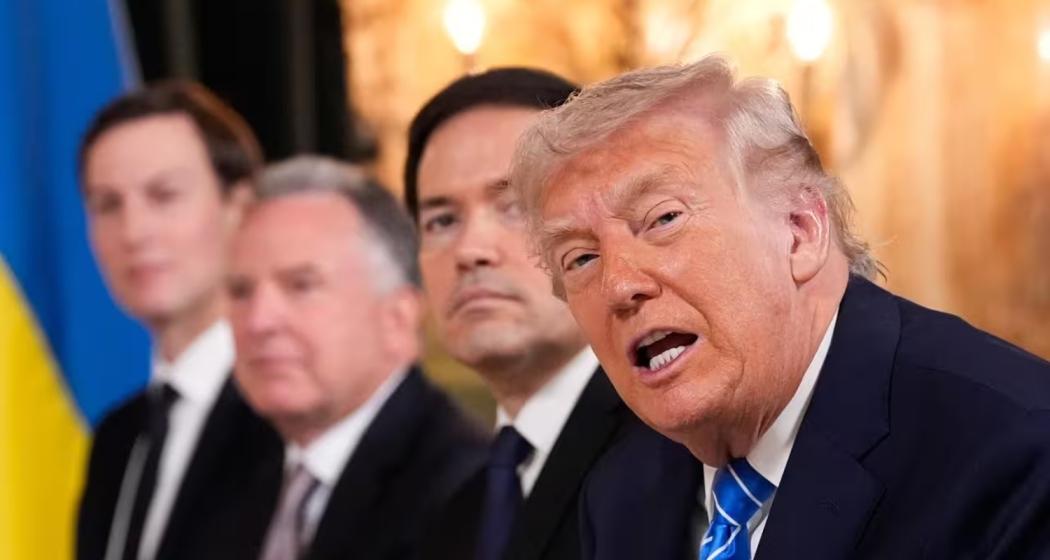
US President Donald Trump on Saturday said he has cancelled the planned visit of US envoys Steve Witkoff and Jared Kushner to Islamabad for negotiations linked to Iran, asserting that Washington retains “all the cards” in the ongoing diplomatic process.
Speaking to reporters, Trump said he had instructed the two envoys not to undertake what he described as “18-hour flights to sit around talking about nothing”, adding that “they can call us anytime they want.”
The development marks a sudden shift in the diplomatic track, coming just a day after the White House indicated that Witkoff and Kushner would travel to Pakistan for another round of discussions aimed at advancing indirect talks with Tehran.
Earlier, Iranian Foreign Minister Abbas Araghchi concluded high-level engagements in Islamabad after meeting Pakistan Prime Minister Shehbaz Sharif and Army Chief General Asim Munir, reinforcing Islamabad’s role as a key intermediary in the evolving US-Iran communication channel.
Iran maintained that no direct talks with the United States are planned, reiterating that communication would continue through intermediaries. Pakistani officials are expected to convey messages between the two sides, even as US envoys Steve Witkoff and Jared Kushner prepare to arrive for a fresh round of negotiations.
Araghchi said discussions focused on ceasefire efforts and regional stability, while also acknowledging Pakistan’s role in facilitating de-escalation.
Iran warns strong response to 'US blockade and piracy'
Even as diplomatic channels remain active, rhetoric from Tehran hardened. Iran’s military warned of a strong response if the US continues what it described as “blockade and piracy” in the region, particularly in the Strait of Hormuz.
Iranian commanders asserted that armed forces remain “ready and determined” to defend national sovereignty, signalling that the fragile ceasefire remains under strain.
Meanwhile, global concerns over energy security intensified, with leaders including French President Emmanuel Macron calling for the full reopening of the Strait of Hormuz to ensure uninterrupted navigation and stabilise global oil markets.
Also read: There will be no direct talks with the US: Iran
Iran reopens Tehran airport
In a sign of cautious normalisation, Tehran’s main airport resumed limited operations after disruptions caused by the conflict. The reopening is being seen as a calibrated step by authorities to restore essential connectivity without signalling a full de-escalation.
Fresh strikes kill 4 in Lebanon as Israel retaliates
At least four people were killed in southern Lebanon’s Yohmor village after Israeli airstrikes targeted a pickup truck and a motorcycle, according to Lebanon’s Health Ministry. The strikes came amid continuing cross-border tensions, even as a fragile ceasefire arrangement remains in place.
Israeli forces said the attacks were in response to rocket fire launched towards northern Israel from Lebanese territory, with sirens activated in border areas including Menara, Margaliot and Misgav Am.
The escalation highlights the persistent volatility along the Israel-Lebanon front, where sporadic exchanges of fire have continued despite diplomatic efforts to contain the conflict.
Longest internet shutdown record
Adding to the crisis, Iran is witnessing what monitoring groups describe as the longest nationwide internet shutdown ever recorded globally.
The blackout, imposed amid conflict and internal unrest, has stretched beyond 50 consecutive days, severely restricting connectivity across the country.
Internet traffic has dropped to a fraction of normal levels, with access largely limited to government-controlled networks and select groups.
The shutdown has had a crippling economic impact, with estimates suggesting losses running into tens of millions of dollars ежедневно, while businesses, communication networks and financial transactions remain severely disrupted.
Global monitors say the scale and duration of the disruption surpass all previous internet shutdowns worldwide, highlighting a new level of digital control during conflict.
Global oil markets remain volatile
Crude oil prices stayed elevated on Saturday as geopolitical tensions linked to the Iran conflict and disruptions in the Strait of Hormuz continued to ripple through global energy markets.
Brent crude hovered above the $100-per-barrel mark this week, with intraday peaks crossing $105–107 levels, marking one of the strongest sustained rallies since early April, according to market data and energy trackers.



 Follow us