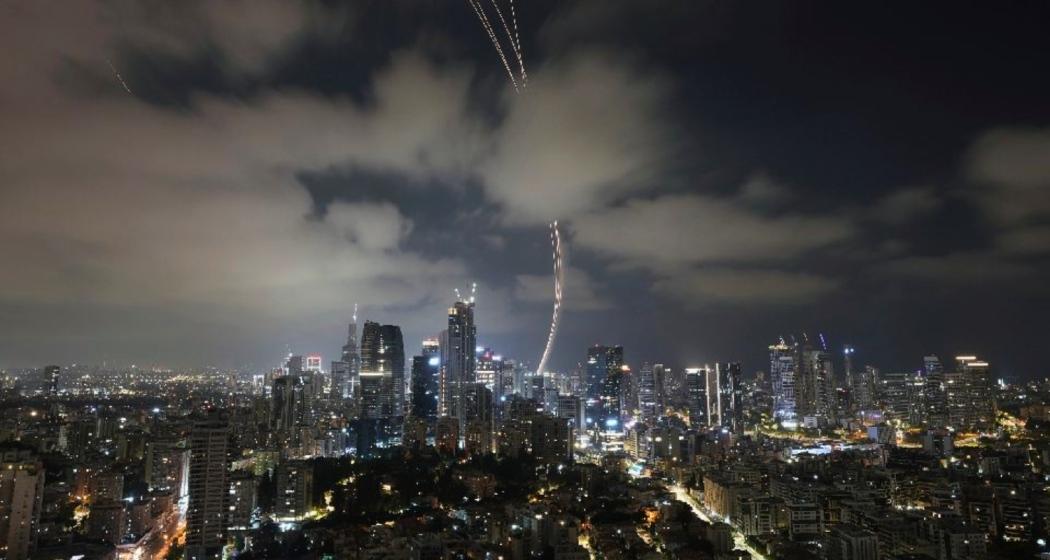
Iran fired a fresh barrage of missiles at Israel and Gulf Arab states on Thursday, signalling sustained offensive capability even as US President Donald Trump claimed the threat from Tehran was diminishing and the West Asia war could end soon.
Explosions were reported in Dubai as air defence systems intercepted incoming missiles shortly before Trump addressed the American public. Sirens also sounded in Bahrain, home to the US Navy’s Fifth Fleet, while Israel said its forces were working to intercept additional projectiles soon after the speech.
Iran responded sharply to Trump’s assertion that US military action had rendered it “really no longer a threat”. A military spokesperson insisted Tehran
retained undisclosed capabilities. “The centres you think you have targeted are insignificant, and our strategic military productions take place in locations of which you have no knowledge and will never reach,” Lt Col Ebrahim Zolfaghari said.
The renewed strikes come amid continuing hostilities across the region. Attacks were reported in multiple Iranian cities on Thursday, while casualties continue to mount. More than 1,900 people have been killed in Iran, compared to 19 in Israel. Over two dozen people have died in Gulf states and the occupied West Bank, while 13 US service members have also been killed.
The conflict has severely disrupted global energy supplies, with Iran maintaining pressure on the Strait of Hormuz, a key maritime chokepoint through which around 20 per cent of the world’s traded oil passes during peacetime. Iranian attacks on commercial shipping and the threat of further strikes have halted most traffic through the waterway.
Also read: Trump says US war objectives near completion, Iran Prez replies
Britain is convening talks with nearly 35 countries to explore options for reopening the strait once hostilities subside. The group, which includes G7 nations except the United States as well as Gulf countries such as the United Arab Emirates and Bahrain, is expected to discuss “viable diplomatic and political measures”, according to Prime Minister Keir Starmer.
Despite calls for coordinated action, no country has signalled readiness to reopen the strait by force while the conflict persists, amid concerns that Iran could continue restricting passage even after active hostilities cease.
The war has triggered sharp increases in energy prices, with Brent crude rising to about USD 108 per barrel, roughly 50 per cent higher than levels recorded before the conflict escalated in late February.
The disruption has also affected jet fuel supplies, with broader implications for global travel and trade.
While the United States has reportedly proposed a 15-point ceasefire plan, Trump did not refer to diplomatic efforts in his latest address, reiterating instead that “core strategic objectives are nearing completion”.



 Follow us