


Trending:
Heartbeat of human history: The Indian Ocean
The Indian Ocean, the warmest and third-largest ocean, has profoundly shaped human history. Its reversing monsoon currents enabled the world's first global trade networks, from ancient Lothal to Chola navies, and today, its chokepoints carry 40% of seaborne oil, defining the Asian century's geopolitical heartbeat. Follow us
- Chandigarh - UPDATED: March 20, 2026, 02:01 PM - 2 min read
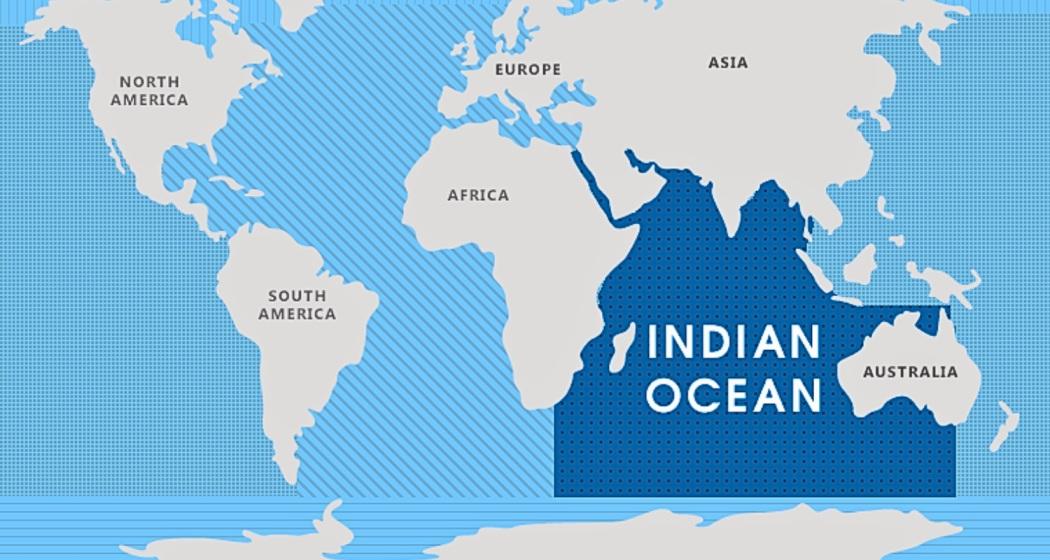
Map highlighting the Indian Ocean region, delineating its boundaries and emphasising its central position between Asia, Africa, and Australia.
Few bodies of water have shaped human destiny as intensely as the Indian Ocean. Spanning 70.56 million square kilometres, counting to roughly 20 per cent of the Earth’s ocean surface, it is the third-largest oceanic division after the Pacific and Atlantic. Its average depth of 3,741 metres plunges to a maximum of 7,450 metres in the Java Trench. It is the warmest ocean on the planet, with surface temperatures often between 22°C and 30°C, and landlocked to the north by the vast Asian continent. This semi-enclosed geography, unlike the open expanses of the other oceans, profoundly shapes its currents, climate influence, and human history.
Extraordinary geography of the ocean
One of the most striking features of the Indian Ocean is the biannual reversal of its surface currents, driven by the monsoon winds. In winter, northeast winds push water westward toward Africa, forming the Somali Current. In summer, as the Asian landmass heats intensely, southwest monsoon winds reverse the flow eastward. This creates powerful upwelling off Somalia, bringing nutrient-rich cold water to the surface and sustaining rich fisheries that support coastal economies across the region.
According to the Intergovernmental Panel on Climate Change (IPCC), the Indian Ocean is warming faster than most other basins, intensifying monsoon variability.
Another geological curiosity is the 90° East Ridge, a remarkable 5,000-kilometre-long submarine mountain chain that runs almost perfectly straight along the 90th meridian east. Formed as the Indian tectonic plate drifted northward over the Kerguelen volcanic hotspot millions of years ago, it records the plate's ancient motion like a scar on the seafloor.
Geographically, the northern rim forms an ‘M’ shape, with the Indian subcontinent jutting out like a wedge between the Arabian Sea and Bay of Bengal, flanked by the Himalayas. This funnels monsoon moisture inland, delivering the intense seasonal rains essential for agriculture across South and Southeast Asia, feeding billions, and supporting civilisations throughout centuries.
Isolated continental fragments add to the oddity of the ocean. The Seychelles are granite remnants of ancient Gondwana, part of the Mascarene Plateau. They host bizarre flora, including the coco de mer palm, which produces the world's largest seed.
Key ecosystems include vibrant coral reefs supporting around 300 coral species and thousands of fish like clownfish, parrotfish, butterflyfish, and surgeonfish, expansive seagrass beds, home to dugongs, ‘sea cows’, and serving as nurseries for fish, turtles, and coastal mangroves.
Iconic fauna includes five of the world's seven sea turtle species, various sharks (whale shark, silky, great white), humpback and blue whales, dolphins, manta rays, sea snakes, and rare/endangered species like the coelacanth. The warm waters also teem with colorful tropical fish, and migratory giants like whale sharks.
Take into account, the Bajau "sea nomads" of Indonesia and the Philippines demonstrate adaptation, with spleens 50 per cent larger than average, enabling dives to up to 200 feet for food, an evolutionary response to their ocean-bound life.
World’s first trade network
The Indian Ocean enabled the world's first truly global economy centuries before the Age of Exploration. By around 100 CE, predictable monsoon winds connected Roman Egypt, Han China, the Mauryan Empire in India, and the Axumite kingdom in East Africa. Goods flowed freely, spices, silk, cotton, ivory, and timber, all without the use of advanced navigation technology.
In the early 15th century, China's Admiral Zheng He led seven massive expeditions between 1405 to 1433 with fleets of over 300 ships, including gigantic treasure ships up to 400 feet long, carrying a crew of 28,000. Reaching Sri Lanka, Arabia, and East Africa, these voyages projected soft power and collected tribute rather than conquest, much of the official record was later destroyed, leaving a historical enigma.
For ancient and medieval India, the ocean was a realm of mastery. From the Harappan dockyard at Lothal (2300 BCE), one of the world's earliest engineered ports, Indian merchants traded beads, cotton, and timber with Mesopotamia. Later, southern dynasties such as the Cholas built formidable navies. Under Rajaraja I and Rajendra I (10th-11th centuries), Chola fleets raided Srivijaya in Southeast Asia in 1025 CE to secure trade routes, extending influence from the Maldives to Sumatra. The ocean was never a barrier but a highway of wealth, protecting pearl, spice, and silk commerce.
European colonisers disrupted this open system. Vasco da Gama's arrival in Calicut in 1498 marked the start of attempts to monopolise trade. The Portuguese imposed the cartaz pass system, demanding tribute for safe passage, a radical shift from centuries of free navigation. Dutch diplomat, Hugo Grotius, however, argued in 1609 that the seas must remain free for all, a principle that still underpins maritime law. Historian Michael Pearson notes that predictable monsoon winds ‘made the Indian Ocean the world’s first commercial highway’.
Today the Indian Ocean has become the geopolitical heartbeat of the 21st century. The International Energy Agency (IEA) estimates that nearly 40 per cent of global seaborne oil passes through these waters, much of it from the Persian Gulf to Asia and Europe.
Critical chokepoints include the Strait of Hormuz (around 20 million barrels per day) and the narrow Strait of Malacca (just 1.7 miles wide at its tightest) and the Bab al-Mandab Strait ( 50 km -113 km wide at the highest). Any disruption here could paralyse the global economy.
The ocean rim is home to 2.7 billion people, one-third of the global population, including India, Indonesia, Pakistan, Bangladesh, and parts of East Africa. By 2050, the region is projected to drive over half of global GDP growth, linking the fastest-expanding economies in a compact basin.
India has increasingly positioned itself as a net security provider in the Indian Ocean, with the Indian Navy maintaining a constant presence across key sea lanes. Powered by platforms such as the aircraft carriers INS Vikramaditya and INS Vikrant, nuclear submarine INS Arihant, and destroyers like INS Visakhapatnam, its modern fleet ensures maritime stability through deployments, anti-piracy patrols and humanitarian missions
The region is however, vulnerable. Low-lying nations like the Maldives (1,192 coral islands averaging just 1.5 metres above sea level) face existential threats from rising seas.
Meanwhile, isolated pockets endure. North Sentinel Island in the Andaman chain remains home to the Sentinelese, who have rejected outside contact for millennia, protected by India's 5-nautical-mile exclusion zone to shield them from outsiders and the disease they carry with them.
For India, the ocean is existential as it supplies the monsoon rains vital for agriculture, carries the bulk of trade and energy imports, and positions the country as the world's busiest sea lanes.
From ancient Lothal to Chola warships and modern naval diplomacy, India has long viewed the ocean as its natural domain. In an era of great-power competition, securing these waters, through initiatives like SAGAR and partnerships like the QUAD, will define India's rise and the global order as control over these waters may well define the balance of power in the Asian century.
The Indian Ocean is blessed with a mysterious geography, reversing currents, tectonic scars, monsoon funnels, unique flora and fauna, and human adaptations, that has shaped civilisations, empires, and now the 21st-century world. As Asia ascends, the ocean stands at the centre of it all.
By Deepan Chattopadhyay
Key data and insights courtesy of the IPCC, IEA, Nature Communications 2024, Petrology journal 2013, and National Geographic.
Historical perspectives informed by scholar, Michael Pearson.