


Trending:
Union Budget 2026: Defence gets huge push for modernisation
In her annual Budget speech in Parliament, Finance Minister Nirmala Sitharaman prioritised sectors hit hardest by Trump’s tariffs and kept the focus on growth via domestic manufacturing boost in a globally-uncertain economic environment Follow us
News Arena Network - New Delhi - UPDATED: February 1, 2026, 03:36 PM - 2 min read
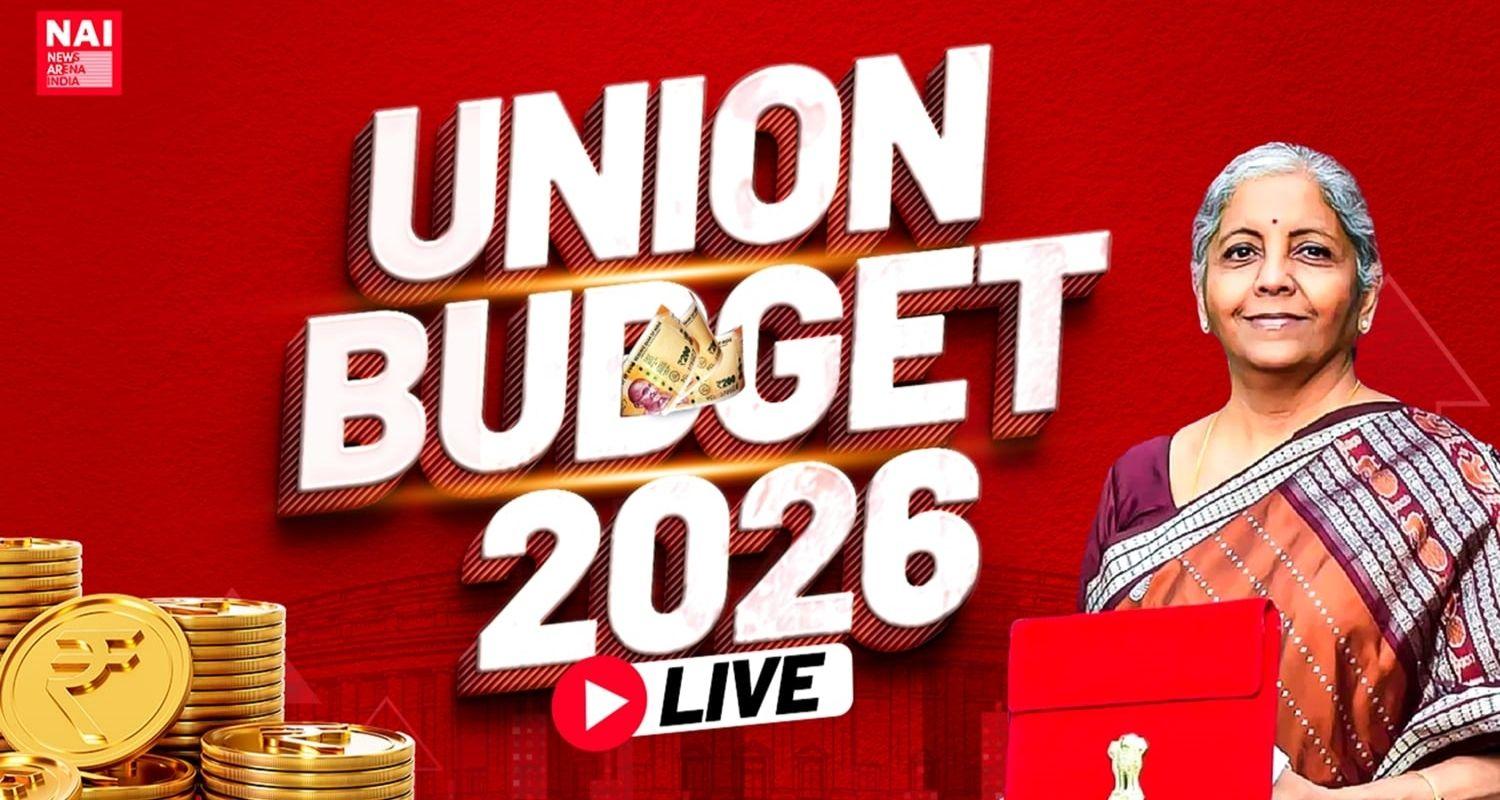
Finance Minister Nirmala Sitharaman presented her ninth consecutive Budget
Finance Minister Nirmala Sitharaman presented the Union Budget 2026 in Parliament on February 1, a Sunday – making it her ninth consecutive Budget since the NDA government came to power.
With an optimistic growth forecast for FY2027 between 6.8-7.2 per cent, as listed in the Economic Survey that was presented in Parliament on January 29, Sitharaman listed out ‘kartavyas’ (duties) for the Centre as the country heads into a new fiscal year and prepares to become the world’s third-largest economy by GDP.
The budget clearly put in spotlight structural reforms, especially in the manufacturing sector, proposed to increase capital expenditure to upgrade infrastructure, and boost the development of technology, artificial intelligence (AI) and rare-earth minerals.
In the current financial year, the Indian economy is seen growing at 7.4 per cent, with inflation expected at around 2 per cent – within the Reserve Bank’s tolerance band. The government’s fiscal deficit for the year is expected at 4.4 per cent of GDP, Sitharaman said, while the fiscal deficit for the new financial year has been forecast at 4.3 per cent.
Also Read: Tax exemption extended on capital goods used in lithium-ion cells
To scale-up manufacturing in pharmaceuticals, semiconductors, chemicals, textiles, sports goods and capital goods, 200 legacy clusters have been proposed. For this, the government will borrow a gross amount of 17.2 trillion rupees from the bond markets.
Additionally, from this year onwards, the government has adopted debt-to-GDP as the target for fiscal policy, and plans to bring down its debt-to-GDP ratio from 56.1 per cent to 55.6 per cent.
To keep the economic growth momentum going, it also plans to spend 12.2 trillion rupees on infrastructure, as compared to 11.2 trillion rupees last year.
In line with its recently-concluded free trade agreement (FTA) with the European Union, Sitharaman also proposed to reduce tariff on all dutiable goods imported for personal use from 20 per cent to 10 per cent.
However, the announcement of hiking STT on futures led to a bloodbath on Dalal Street, with the Sensex plunging 2300 points and Nift below 25,000.
Sitharaman’s Budget speech was broadcast live on Sansad TV.
Live Updates
2026-02-01T15:35
First Budget after Operation Sindoor, defence gets huge push for modernisation
The Union Budget has raised defence capital spending to ₹5.95 lakh crore from ₹4.92 lakh crore last year, marking a 22% increase, while funds specifically for modernisation have been boosted by 24%.
2026-02-01T15:25
No relief for income tax payers
Taxpayers who will navigate the new Income Tax Act from April 1 should expect tax rebates or Standard Deduction changes. Sitharaman announced a tax holiday - till 2047 - to any foreign company providing cloud services by setting up data centres in India and proposed a simplified tax regime for corporates. She also announced a rationalisation of the prosecution framework under the new Income Tax Act.
2026-02-01T15:19
Budget charts clear roadmap for Viksit Bharat: PM Modi
Terming the Union Budget as ‘historic’, he said it reflected the aspirations of 140 crore Indians, presented an ambitious roadmap to give new push to Make in India, Aatmanirbhar Bharat initiatives
2026-02-01T12:44
Bloodbath on Dalal Street
Sensex crashes 2,300 pts; Nifty below 25,000 after Sitharaman raises STT on futures
2026-02-01T12:26
‘Tax holiday’ for foreign cloud firms
The Finance Minister proposed to provide a ‘tax holiday’ until 2047 to all such foreign companies that provide data cloud services to Indian citizens from data centres in the country.
2026-02-01T12:20
Exemption of basic duties on components required in solar and aircraft industries
There will be provision of exemption of basic duty on import of components and parts required for the manufacturing of aircraft, as well as their maintenance and repair, said FM Sitharaman in her Budget speech, adding that there will also be exemption of basic duties on components required to create solar cells and panels.
2026-02-01T12:14
Govt to set up high-powered ‘Education to Employment’ panel to assess AI impact on jobs
FM Sitharaman announced the setting-up of an Education to Employment and Enterprises Standing Committee to assess the impact of emerging technologies, including artificial intelligence, on jobs and skill requirements and strengthen employment opportunities. Sitharaman said the services sector holds the potential to position India as a global leader, with a target of achieving a 10 per cent share in the global services market by 2047. She said the committee will prioritise key areas to optimise the potential for growth, employment generation, and exports. Based on its assessment, the committee will propose measures to ensure that the workforce is equipped to adapt to technological changes. "They will also assess the impact of emerging technologies, including AI, on jobs and skill requirements and propose measures thereof," she said.
2026-02-01T12:01
Kept my promise of reducing fiscal deficit: FM
Finance Minister Nirmala Sitharaman said she had been successful in reducing the country’s fiscal deficit to 4.3 per cent of the GDP for 2026-27.
2026-02-01T12:00
16th Finance Commission recommendations on state-sharing of revenue pool retained
The government has decided to retain the 41 per cent share of states in Centre’s revenue-sharing pool, said FM Nirmala Sitharaman in her Union Budget speech.
2026-02-01T11:58
Mental health care via NIMHANS 2
NIMHANS 2 to come up for specialised mental health and trauma care, said Finance Minister Nirmala Sitharaman. Hospitals to also get updated emergency and trauma care centres, she added.
2026-02-01T11:47
2026-02-01T11:44
New National Institute of Design in eastern India
Design study to be upgraded with the establishment of design schools, including one in eastern India
2026-02-01T11:41
Special geriatric care and medical tourism to get a boost
Five regional medical hubs to be established to encourage medical tourism in the country, said the FM. These will amp-up job opportunities for medical care-givers. Three new, state-of-the-art Ayurvedic institutes to come up.
2026-02-01T11:34
Outlay on electronics manufacturing to be increased to ₹40,000 crore in FY27
Finance Minister Nirmala Sitharaman proposed to increase the outlay on electronics manufacturing to ₹40,000 crore in the 2026-27 fiscal year, which includes setting up high-tech tool rooms at two locations to give push to capital goods manufacturing. Sitharaman also proposed a scheme for container manufacturing to create globally competitive ecosystem. Three dedicated chemical parks will also be set up to enhance domestic production, reduce import dependency, she added.
2026-02-01T11:22
₹10,000-crore budget for SME growth Fund: FM
Finance Minister Nirmala Sitharaman, in her Union Budget speech, talked of the government’s special focus on small and medium enterprises that includes a ₹10,000-crore budget for SMEs. Other major sectors that she mentioned are the handloom industry (including textiles, weaving, artisanal industries) and mining, especially rare earth mining. Sports good manufacturing will also receive a major boost.
2026-02-01T11:13
FM lists major strategic reforms
In her Union Budget 2026 speech, Finance Minister Nirmala Sitharaman listed out major areas that her government will focus on in the coming year, including: Scaling up manufacturing in 7 strategic sectors; rejuvenating industrial sectors; infrastructure push; enhance long-term security and develop City Economic Zones.
2026-02-01T10:57
FM begins her Parliamentary Budget speech for 2026-27
Finance Minister Nirmala Sitharaman begins her Union Budget speech for 2026-27, talks of the NDA government’s “far-reaching structural reforms”.
2026-02-01T10:52
Cabinet approves Union Budget 2026-27
The Union Cabinet headed by Prime Minister Narendra Modi on Sunday approved the Union Budget 2026-27. Following the approval, Finance Minister Nirmala Sitharaman will present her ninth record Budget in the Lok Sabha that comes in the backdrop of global uncertainties and slowdown in exports. This is the third Budget of the BJP-led NDA government in its third term in office.
2026-02-01T10:15
FM dons Kanjeevaram saree from TN; A lowdown on all the sarees she wore these past nine years for her Budget speeches
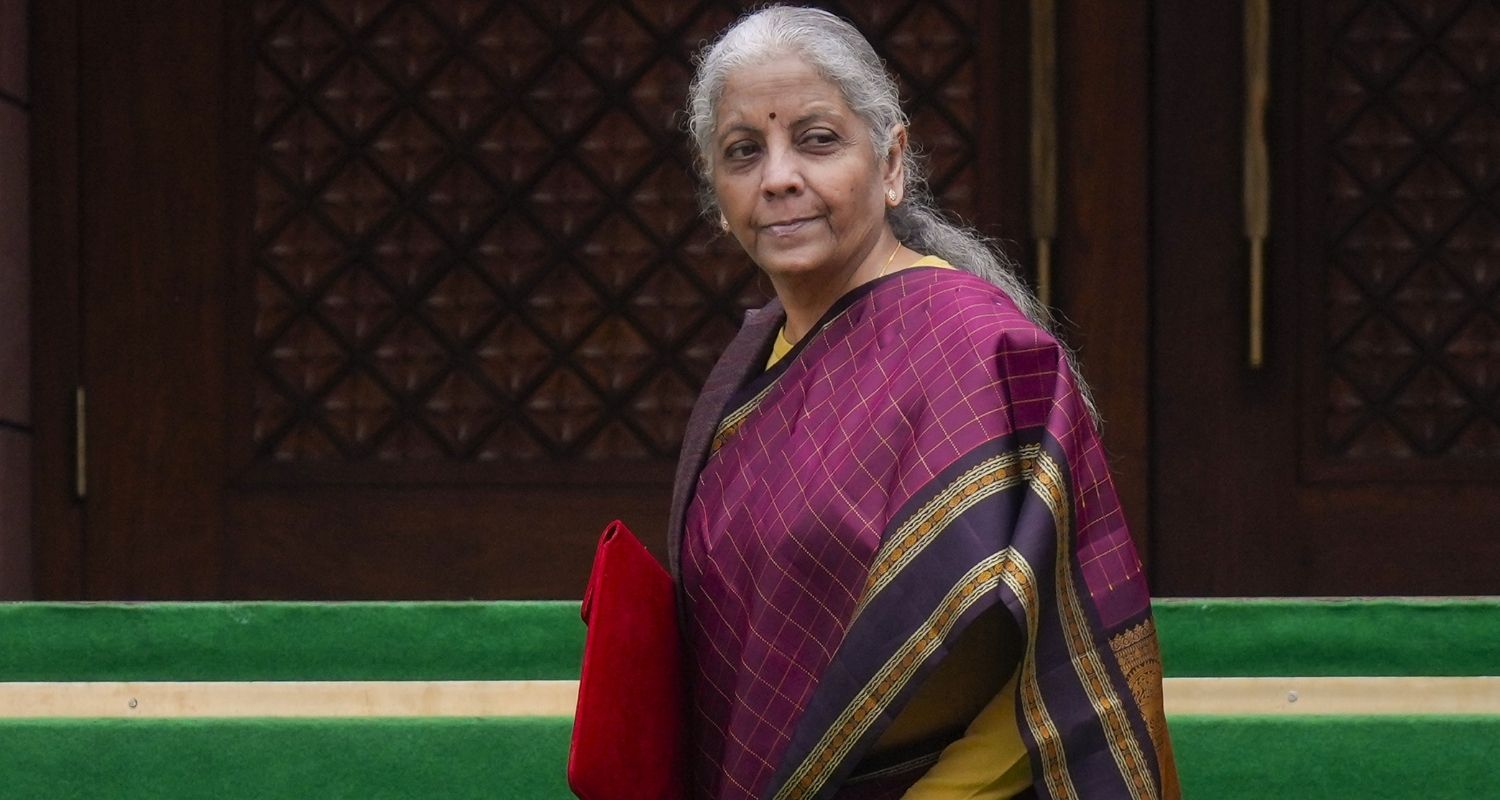
FM Nirmala Sitharaman will table the ninth Union Budget 2026 in a Kattam Kanjeevaram silk saree from Tamil Nadu, representing the state’s rich cultural legacy. The minister’s magenta saree has golden-coloured kattam (checks) and a coffee brown border with intricate threadwork. She has paired it with a plain yellow blouse. Kanjeevaram sarees are worn on special occasions, such as weddings. Weavers in Kancheepuram often draw inspiration from the rich temple architecture to design the sarees. The silk weaving tradition in the state goes back to the Chola period (9th-13th centuries). Last year, Sitharaman wore a cream-coloured handloom saree with Madhubani motifs of fish, presented to her by 2021 Padma Shri awardee Dulari Devi, who hails from a Dalit fishing community. In 2019, the FM wore a pink Mangalgiri silk saree with gold borders for her Budget speech. In 2020, she had donned a yellow silk saree with green-lined borders. And in 2021, she chose a red and off-white Pochampally silk saree from Telangana. In 2022, Sitharaman opted for a brown and maroon-colored Bomkai saree from Odisha. In 2023, she wore a red silk saree with Black Kasturi embroidery, made in Karnataka. In 2024, she had on a blue Tussar silk saree with Kantha embroidery from West Bengal while presenting the interim Budget. For the Union Budget that year, she put on a white-coloured silk saree with magenta-coloured borders and golden motifs. The Budget session will span 30 sittings over 65 days, concluding on April 2. The two Houses will adjourn for a recess on February 13 and reconvene on March 9 to enable the Standing Committees to examine the Demands for Grants of various ministries and departments.
2026-02-01T10:11
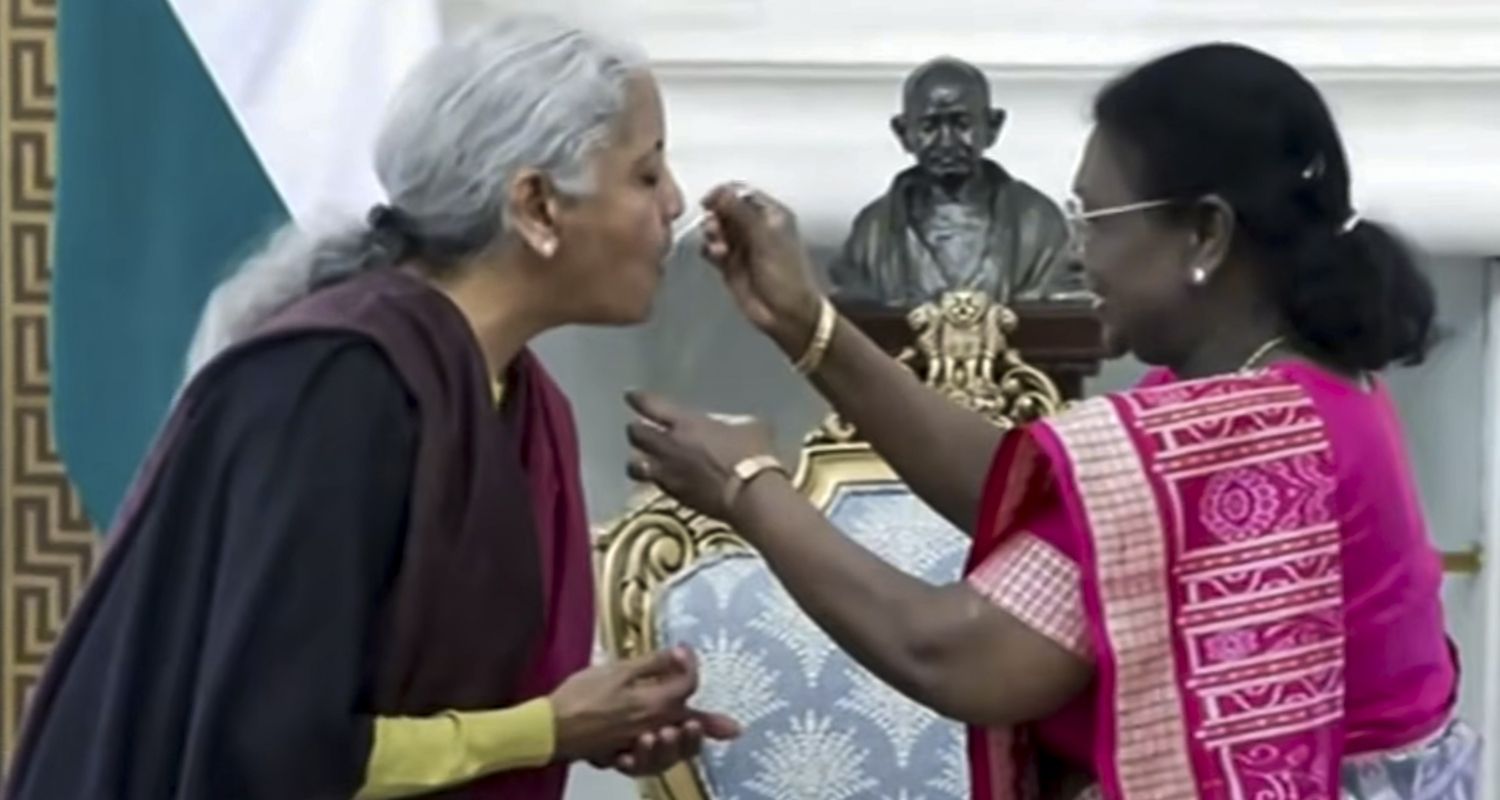
President Droupadi Murmu offers dahi cheeni to Finance Minister Nirmala Sitharaman before the latter presents the Union Budget 2026-27 in the Lok Sabha, in New Delhi.
2026-02-01T10:07
Finance Minister Nirmala Sitharaman arrives at the Parliament to attend the Cabinet meeting ahead of presenting the Budget 2026-27
Finance Minister Nirmala Sitharaman arrived at the Parliament to attend the Cabinet meeting ahead of presenting the Budget 2026-27 in Lok Sabha. The Union Cabinet, headed by Prime Minister Narendra Modi, will approve the Union Budget 2026-27 in Parliament. Sitharaman, who met President Murmu in a customary trend before heading to the Parliament, is set to present her ninth consecutive Union Budget, this time for the financial year 2026-27. According to the List of Business, the Lower House will meet at 11 am and Sitharaman will present a statement of the estimated receipts and expenditure of the Government of India for the year 2026-27. She will also lay on the table two statements under Section 3(1) of the Fiscal Responsibility and Budget Management (FRBM) Act, 2003. These include the Medium-term Fiscal Policy-cum-Fiscal Policy Strategy Statement and the Macro-Economic Framework Statement. The List of Business further states that Sitharaman will move for leave to introduce the Finance Bill, 2026, in the Lok Sabha.
2026-02-01T09:41
FM Sitharaman meets President Murmu for a customary pre-Budget presentation meeting
Having reached the Rashtrapati Bhavan before heading to Parliament, FM Sitharaman called on President Droupadi Murmu as per established norm. The minister has donned a magenta silk saree today. She also posed with her Budget team in front of her office at Kartavya Bhavan. Following the meeting, she headed for a Cabinet meeting that will formally approve the Budget for 2026-27.
2026-02-01T09:29
Stock markets remain in narrow range; gold and silver prices hit lower circuit
Gold and silver prices remained in the lower range of the circuit ahead of the Union Budget presentation, after yesterday’s crash. In a first, stock markets will also remain open on Sunday, February 1. Benchmark indices remained fluctuating in a narrow range in early trade.
2026-02-01T09:25
Sitharaman leaves for Rashtrapati Bhavan with ‘Digital Bahi-Khata’ ahead of Union Budget presentation
Union Finance Minister Nirmala Sitharaman left from Kartavya Bhavan for Rashtrapati Bhavan carrying her trademark ‘bahi-khata’, a paperless form of Budget presentation, as has been her tradition since the past four years. Sitharaman carries a tablet wrapped in a red-coloured cloth bearing a golden-coloured national emblem on it when presenting the Budget. Union Minister of State for Finance Pankaj Chaudhary, Chief Economic Advisor Dr V Anantha Nageswaran, Chairman of the Central Board of Direct Taxes (CBDT) Ravi Agrawal and other officials of the Finance Ministry were seen accompanying the Finance Minister.
2026-02-01T09:11
Finance Minister Nirmala Sitharaman arrives at Kartavya Bhawan
2026-02-01T09:08
Finance Minister Nirmala Sitharaman arrives at Kartavya Bhawan ahead of Union Budget
Union Finance Minister Nirmala Sitharaman and MoS Pankan Chaudhari have arrived at the Kartavya Bhawan on Sunday ahead of the presentation of the Union Budget 2026-27 in the Lok Sabha during the ongoing Budget session of Parliament.
2026-02-01T09:05
Indian economy to grow at 7.4 pc in FY 2025-26: Goyal
Referring to the Economic Survey 2025-26, Union Minister Piyush Goyal noted that the First Advance Estimates project real GDP growth at 7.4 per cent for the Financial Year (FY) 2025-26, reinforcing India’s position as the fastest-growing major economy for the fourth consecutive year. “The Indian economy has sustained strong momentum, with the First Advance Estimates projecting real GDP growth at 7.4 per cent for FY 2025-26. This underscores India’s position as the fastest-growing major economy for the 4th consecutive year,” Piyush Goyal wrote on X on Thursday. Goyal noted that India recorded an inflation rate of 1.7 per cent during April-December 2025, largely due to a contraction in food prices for key commodities like vegetables and pulses, demonstrating effective inflation management by the government. He also emphasised the government's focus on strengthening manufacturing, describing the progression from 'Swadeshi' to 'Strategic Resilience' and now 'Strategic Indispensability', aimed at promoting confidence in 'buying Indian without thinking'. The Budget session will span 30 sittings over 65 days, concluding on April 2. The two Houses will adjourn for a recess on February 13 and reconvene on March 9 to enable the Standing Committees to examine the Demands for Grants of various ministries and departments.
2026-02-01T09:03
Break from tradition: FM to address Part B of the speech first
In what is being seen as a big break from tradition, for the first time in 75 years, the finance minister is expected to begin her speech with Part B, which usually deals with tax and policy announcements. As she reveals the roadmap for India’s economic future, Part A – the more substantial part of the speech – will be relegated to the last as Sitharaman lists out short-term priorities and long-term goals in the second quarter of the 21st century.
The Finance Minister will also lay on the table two statements under Section 3(1) of the Fiscal Responsibility and Budget Management (FRBM) Act, 2003. These include the Medium-term Fiscal Policy-cum-Fiscal Policy Strategy Statement and the Macro-economic Framework Statement. The List of Business further states that Sitharaman will move for leave to introduce the Finance Bill, 2026, in the Lok Sabha. She will also formally introduce the Bill. The Finance Bill gives legal effect to the financial proposals of the government.