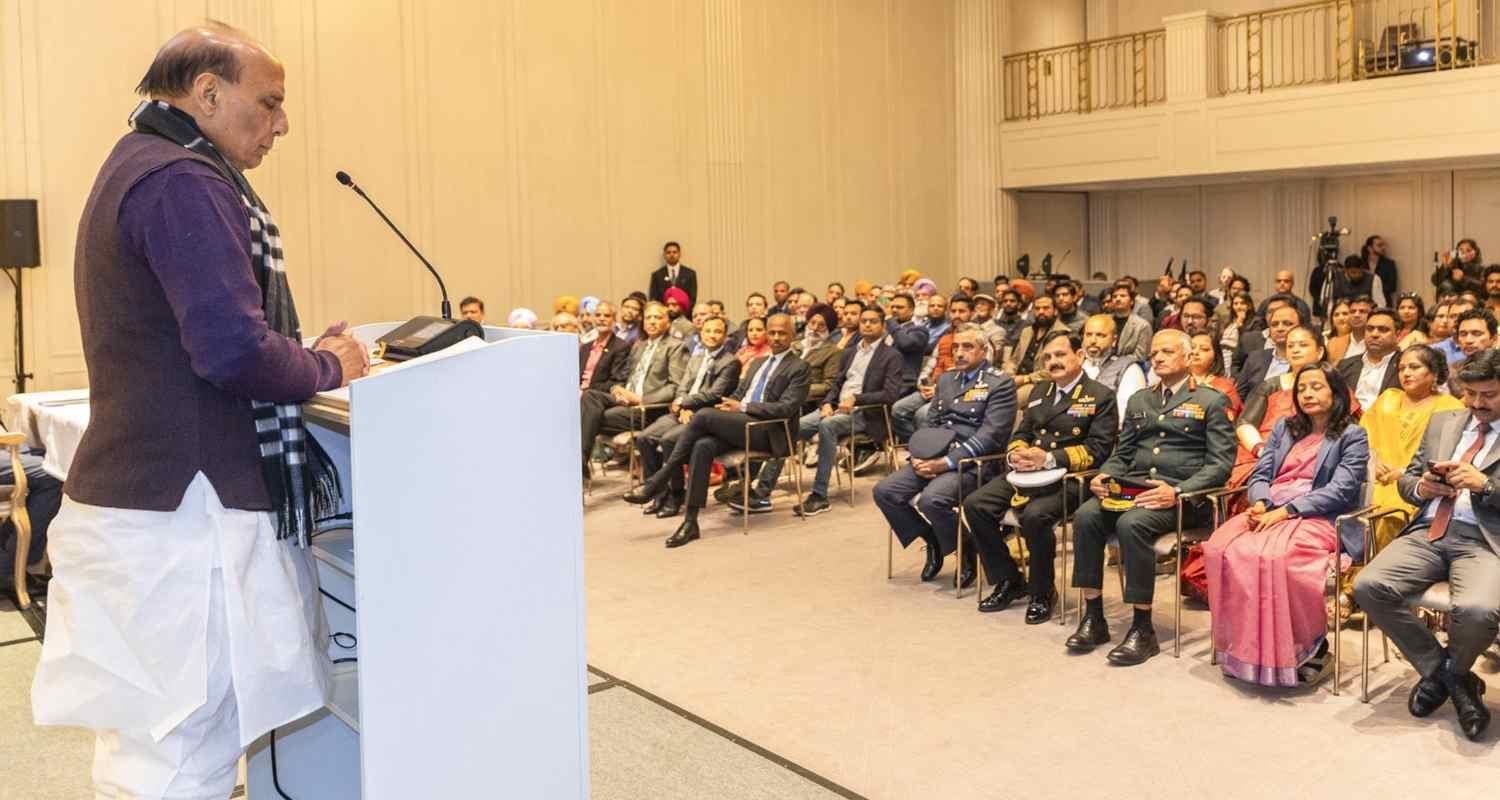
India’s Defence Minister Rajnath Singh, currently on an official visit to Germany, addressed the country’s Parliamentary Standing Committee on Defence and Security, highlighting the evolving nature of global threats and the increasing complexity brought about by rapid technological transformation.
Speaking on Tuesday, Singh noted that the world is confronting new and interconnected security challenges, stressing that adapting to this changing environment is essential. He also made a strong case for deeper collaboration between the defence industrial ecosystems of India and Germany.
His visit comes at a time when the ongoing crisis in West Asia has persisted for over 50 days, creating significant global repercussions. Singh pointed out that for a country like India, which depends heavily on the region for energy supplies, any disruption in the Strait of Hormuz poses serious risks.
“For a developing country like India, which relies on the West Asian region for a significant share of its energy requirements, disruptions in the Strait of Hormuz are not distant events; they are stark realities with direct implications for our security and economic stability,” he said.
In light of such challenges, Singh said India has adopted a proactive and coordinated approach. He underlined the importance of collective responses and trusted strategic partnerships to address modern global threats effectively. He also highlighted that Prime Minister Narendra Modi and German Chancellor Friedrich Merz have placed strong emphasis on strengthening bilateral strategic ties.
“We also see a clear convergence of views at the European Union level,” Singh said, referring to growing engagement through the European Union, including initiatives like the India–EU Defence and Strategic Partnership. The minister further emphasised that the Aatmanirbhar Bharat initiative is not merely about procurement, but serves as an invitation for global partners to co-create, co-develop, and co-innovate with India.
He acknowledged Germany’s strong industrial base, including its leading enterprises and the renowned Mittelstand—its network of small and medium-sized companies known for excellence in advanced technologies. Singh added that India’s growing start-up ecosystem and private sector are complementing its established defence capabilities, creating natural synergies for deeper cooperation between the two nations.
“We are established democracies bound by shared values and dynamic economies driven by resilience, innovation, and a determined industrial spirit,” Singh said, urging lawmakers to support further strengthening defence and strategic cooperation. He expressed confidence that the India-Germany partnership would be seen as a model of diplomacy, built not out of crisis but through sustained commitment between two mature democracies.
Singh also cautioned that current geopolitical instability should not be viewed as limited to specific regions, as its consequences extend globally. He noted that such developments impact not only energy supplies but also food security, economic stability, and carry significant humanitarian costs.
Upon his arrival in Berlin, Singh was accorded a ceremonial welcome with military honours. He was flown from Munich to Berlin aboard a special German Air Force aircraft, escorted by fighter jets, according to a statement from the Defence Ministry.
Earlier, he paid floral tribute to Rabindranath Tagore at the premises of Humboldt University, highlighting the enduring cultural and intellectual ties between India and Germany.



 Follow us