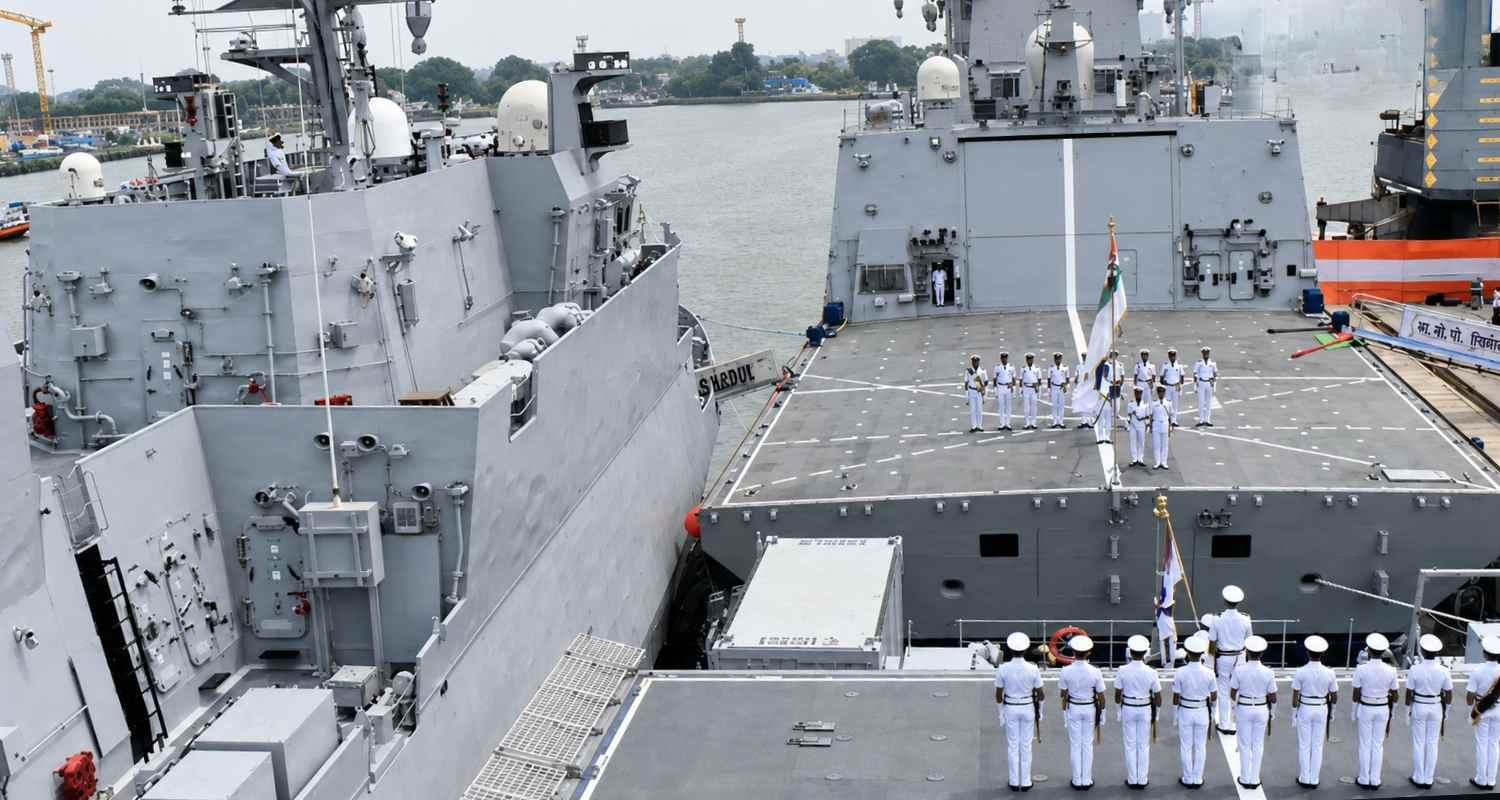
Prime Minister Narendra Modi on Sunday inaugurated three state-of-the-art naval warships in Kolkata on Sunday, marking a significant boost to India’s maritime strength and indigenous defence capabilities. The event took place at the Syama Prasad Mookerjee Port on the final day of his two-day visit to West Bengal.
Earlier in the day, the Prime Minister attended a programme at Red Road in Kolkata to commemorate the 12th International Yoga Day. He later arrived at Garden Reach at around 9:30 am. He was accompanied by Chief Minister Suvendu Adhikari and Governor R.N. Ravi during the naval inauguration ceremony.
The Indian Navy expressed its gratitude to the Prime Minister for promoting indigenous warship construction, highlighting the importance of self-reliance in strengthening maritime defence. Commanding Officers of INS Dunagiri, INS Ajay, and INS Sanshodhak also addressed the gathering.
Addressing the event, Modi said, “The entire world is watching Kolkata today. I feel proud to be here at this august moment. This is the land that showed the path of the Renaissance. This is the land that connects India with the rest of the world. The waters of the Hooghly River have witnessed many historic moments. Bengal will soon become a key driver of India’s development.”
Emphasising the importance of naval strength, he added, “I congratulate all the scientists, engineers, and personnel associated with the Indian Navy. No country’s security system is complete without a strong maritime presence. A nation’s economic growth and strategic strength depend significantly on its maritime security.”
The three warships—INS Dunagiri, INS Ajay, and INS Sanshodhak—have been constructed by Garden Reach Shipbuilders & Engineers (GRSE) in Kolkata and are being inducted into the Indian Navy simultaneously. Defence experts believe this induction will significantly enhance India’s capabilities in maritime warfare, anti-submarine operations, and hydrographic surveys.
This marks the second recent instance of three major naval vessels being commissioned together. In January 2025, Modi had inaugurated INS Surat, INS Nilgiri, and INS Vagshir at the Mumbai Naval Dockyard.
All three newly inducted ships have been built using entirely indigenous technology and designs developed by the Indian Navy’s Warship Design Bureau, underscoring the success of the ‘Atmanirbhar Bharat’ initiative in the defence sector.
INS Dunagiri, built under Project 17A, is the fifth frigate in its class and the second constructed at GRSE. It is equipped with BrahMos supersonic cruise missiles, surface-to-air missiles, and advanced weapon systems. The vessel also features modern technologies such as CODOG (Combined Diesel or Gas) propulsion and an Integrated Platform Management System. Notably, its construction was completed in just 80 months.
INS Ajay is part of the Arnala-class series of shallow-water anti-submarine warfare ships. Designed for coastal defence, it is equipped with lightweight torpedoes, indigenous anti-submarine rocket launchers, and advanced surveillance systems, making it crucial for detecting and neutralising underwater threats.
INS Sanshodhak is the fourth and final vessel of the Sandhayak-class survey ship project. Measuring approximately 110 metres in length and displacing around 3,300 tonnes, the ship is equipped with Autonomous Underwater Vehicles (AUVs), Remotely Operated Vehicles (ROVs), and sophisticated hydrographic survey systems. It will play a key role in seabed mapping, charting waterways, and ensuring safe marine navigation.
Defence analysts note that the simultaneous induction of these vessels significantly strengthens the Indian Navy’s operational readiness. The Prime Minister also emphasised that these ships symbolise India’s growing self-reliance and technological advancement in the defence sector.



 Follow us